

My Christmas tree is common – but who cares?
- Etiquette experts call flashing multicolour lights, plastic stands and novelty baubles vulgar, while a kitchen-counter tree breaks their rules.
- Mair says minimalist trees and inherited ornaments signal cultural capital, but ideas of good taste are learned class snobbery, not objective measures.
- The writer chooses a practical, child- and dog-friendly tree filled with handmade crafts and family keepsakes, valuing shared memories and joy over status. Read more
The festive season is barreling down upon us – having officially started today, according to most Brits – and that means Christmas tree snobbery is already rife, with various declarations of what is in and out for your decorations this year.
For some, the more Instagrammable a tree, the better. They become a status symbol to deck out in over-the-top huge red bows, like Amanda Holden’s 2025 tree, or Mariah Carey’s, which last year was so huge and sparkly it wouldn’t have looked out of place on Oxford Street. Kim Kardashian’s Christmas trees were spray-painted in white snow and lined her hallways. Bit, whisper it, they all share a look - they are apparently all very common.
Whether it’s social media to blame – or just naffness – or a revolt against one’s traditional background by going AWOL with kitsch baubles, there is no escaping the judgement and pressure. And my Christmas tree plans have already ticked many of this year’s no-nos.
My biggest sin? I have multi-coloured flashing fairy lights on my Norway Spruce Christmas tree, instead of clear or white ones.
Yes, that’s right – and possibly worse still, I also have a garish green plastic base holding the tree in place with black clamps that I don’t try to disguise with a wicker basket, or a bucket wrapped in green or red crepe paper.
My other ‘sin’? The tree sits on the top of the kitchen counter next to the washing machine, so that my dog can’t attack it. Last year, the whole tree fell off when I put the washing machine on for a fast spin and drain, and I lost a lot of family glass baubles lovingly wrapped in tissue paper in an old Fortnum’s box– which means I replaced them with others, including a big blue Disney Frozen one with Elsa (vulgar) and food-themed motifs like avocado on toast. This all points to one result.
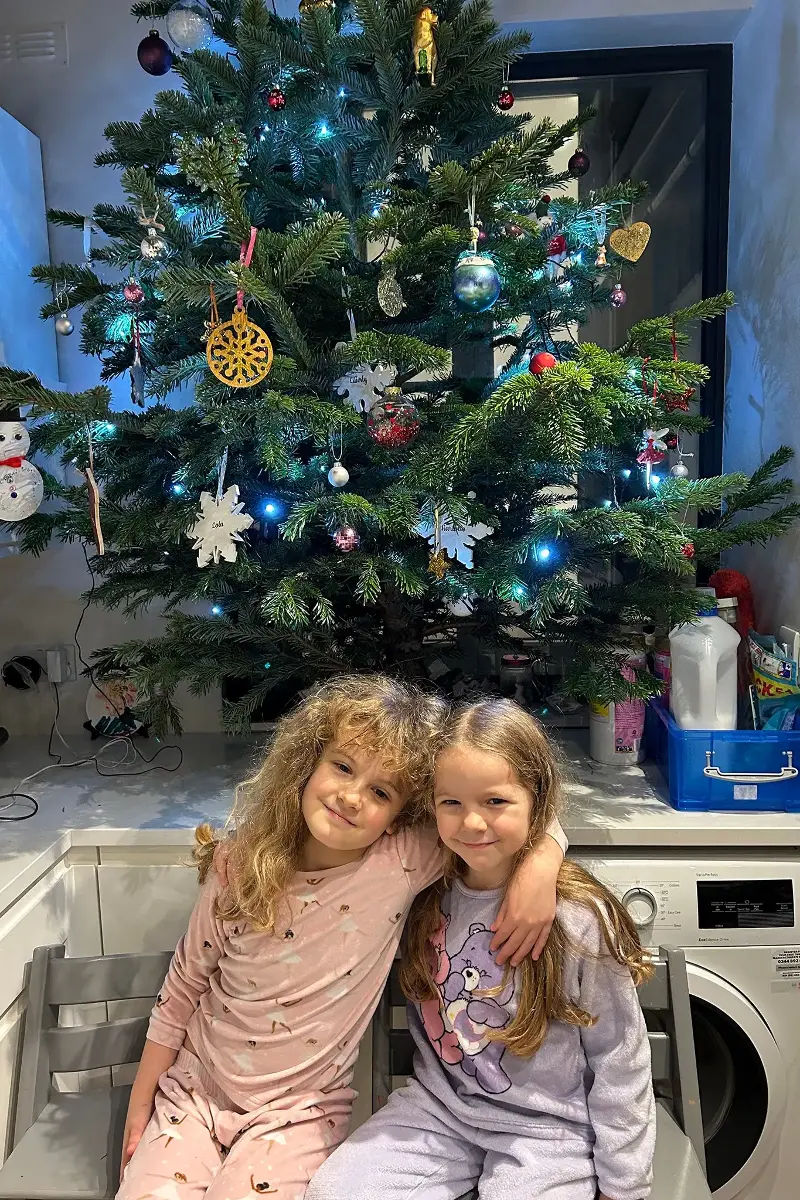
My Christmas tree is apparently desperately “common”. In fact, talk to any seasonal etiquette expert, and practically everything I’m doing with my Christmas tree is considered vulgar and declasse.
It might have a fabulous pine needle aroma and generously full branches that make the nearby Ikea cupboard doors hard to open. But I still have to lop it off at the top so it fits in the space I have. This is an absolute no-no in smart circles where the expectation is that your tree is so grand that it grazes the ceiling nicely, and is placed in its full glory in an expansive entrance hall, or even better, the drawing room.
Not for them, dragging it back to the car. True class comes with a delivery from a bijou company who will have trimmed elegantly for you before it arrives.
However, my mish-mash of crooked DIY snowmen and stars made out of paper and foil by my two children at nursery does score plus points in taste. In high-falutin circles, families have a simple star or angel at the top of the tree that is passed down through the family generations like a christening gown; I have a golden retriever bauble. But sadly I only have one tree, not two – which is a dead giveaway of being in the “common” camp, because it means my house is embarrassingly too small to accommodate the full mini-forest.
Also, I shouldn’t even have my tree up by now. According to upper-class traditionalists, I should really be waiting until mid-December, or even Christmas Eve – which feels like it could count as cruelty to children. Something that upper-class traditionalists also excel at, to be fair.
The presents around the tree should be wrapped in wrinkly old paper you found in an old drawer of a desk that might have belonged to your great-great-grandfather, and the tags cut from decades-old charity Christmas cards, punctured with a hole and a ribbon pulled through it, as we did it in my childhood.
That means a neatly stacked mountain of presents with personalised ballerina fairy Christmas wrapping paper is a crime – and one I commit happily for all the time-saving points it gives me. Class and Christmas, I find, turn everything on its head – what you think is posh (ie expensive wrapping paper) actually gives you away as terribly common.
But most offensive – according to etiquette – is my decision to also get a pre-lit fake Christmas tree this year so I can transport it to a luxury barn we’re staying in a remote corner of north Cornwall, even though the best ones don’t come cheap; a six-foot one at Selfridges is £650.
Worse, of course, is if you add a tree skirt with motifs such as Highland cows, snowmen, gingerbread houses, waving Santas, or sparkly bows. To rename it “a winter celebration tree” is literally the final straw.
But, should I really worry about adding any tinsel colour that isn’t silver in case I break the unspoken less-is-more look of my tree that still divides the UK class system?
Apparently not, according to Dr Carolyn Mair, chartered psychologist and author of The Psychology of Fashion. “Understated decorations, inherited ornaments and an appearance of effortless taste may communicate cultural capital rather than financial wealth,” she says. “But there’s nothing inherently more sophisticated about a minimalist tree. These are socially learned judgements and a form of class-based snobbery.”
My biggest sin? I have multi-coloured flashing fairy lights instead of clear or white ones
Social class is so often communicated through material goods, Dr Mair adds, because possessions are visible, whereas wealth, education, family background and social position aren’t always immediately apparent.
Importantly, class isn’t communicated through price alone. “Knowing which objects are considered tasteful, how to display them and when to avoid obvious displays of wealth can itself signal cultural capital.” But she adds that while this all reinforces class stereotypes, “they tell us very little about the individual.”
Luckily, she says, “status anxiety” isn’t inevitable. “It’s important not to interpret someone’s decorating preferences as evidence of emotional insecurity. A lavish tree might reflect genuine enjoyment, while a modest tree might reflect preference rather than financial constraint,” she adds.
So there we have it. This Christmas I’m choosing joy over class. My Christmas tree might be common, but it’s one that is full of memories, old and new, and that whether it’s the right look or not is what we should really be celebrating.