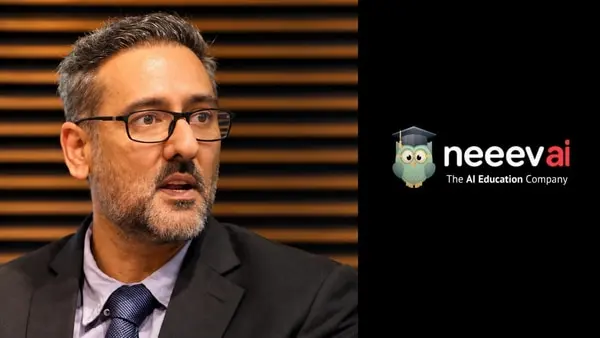

AI education should start early.
- Dr. Arjun Bedi's NeeevAI aims to integrate AI education into 25,000 schools, reaching 3.1 million students by 2027 with a comprehensive curriculum.
- The program emphasizes hands-on learning, ethics, and entrepreneurship, preparing students to become builders of AI by Class 12.
- NeeevAI collaborates with tech giants like Google and Canva, positioning itself as a partner to enhance AI education while ensuring compliance. Read more
Can artificial intelligence become a regular subject in schools, alongside mathematics and science? Dr. Arjun Singh Bedi, founder of NeeevAI, is betting on this possibility. NeeevAI began as his doctoral dissertation project and had its first two schools in April 2025.
The company says it is now contracted to reach 25,786 schools and about 3.1 million students by April 2027. Its programme combines an AI curriculum, textbooks, robotics kits, teacher training and hands-on learning, and its ecosystem includes an AI hackathon app, Nova, and an internship app, Argo.
In an exclusive interaction with Mint, Bedi, who sits on UNESCO’s Global Responsible AI Council, discusses why AI belongs in school, how NeeevAI’s offering fits together, the challenges of convincing schools across India, and what students should know about AI by the time they finish Class 12. Edited excerpts:
How do you see AI transforming school education over the next five years? Will it become a mainstream subject in its own right, or will AI literacy be integrated into every subject?
Both. First, AI will personalise learning in every subject, acting as a patient tutor for each child. Second, AI will become a subject in its own right: students will learn its building blocks and how to build AI projects, products and platforms, whether they are technical or not. The goal is to turn students from users into builders of AI. NeeevAI began as my doctoral project asking why a child should wait until college to do that.
Entrepreneurship will also move to the front of school life, so teaching must shift towards projects, real problems and teachers who coach. By Classes 11 and 12, I expect AI to merge with streams: AI in Healthcare for medical students, Finance for commerce, Advertising and Journalism for arts, and Robotics and Manufacturing for non-Bio science.
If AI becomes as fundamental as mathematics or English in the next five years, what should an Indian student know about AI by the time they finish Class 12?
I think of it as a formula. A student should understand how AI works and why it can be wrong, use it well, and have built real things with AI and robotics. They should pair AI with domain knowledge, knowing the trends and gaps in an industry. And AI ethics is essential: every NeeevAI textbook has a mandatory chapter on UNESCO’s Ethical AI Framework.
Then comes readiness: the AI Annual Day to build and present a product, hackathons on our Nova app within their age group, internships through Argo, AI certification, and AI career options, which our textbooks cover from Class 6. That is what we mean by From Classroom to Career.
You have authored 12 AI textbooks for Classes 1–12. How do you keep them relevant as AI technology evolves so rapidly?
By teaching what changes slowly, such as data, bias and the human role in decisions, and staying close to where AI is changing fast. Each book covers six aspects: computer science, UNESCO’s Ethical AI Framework, the AI curriculum, AI robotics, the AI Annual Day with entrepreneurship, and internships.
We stay current through industry trainings and projects, PhD-qualified teachers, and my co-founder, a PhD in AI who leads our curriculum. I sit on UNESCO’s Global Ethical AI Council, and we have credible advisors, TiE and industry events, and our own R&D. It reaches teachers quickly: this week our PhD in AI Robotics is giving a refresher to all our educators. Newsletters and social media keep parents and schools updated.
With children as young as six being introduced to AI, how do you address concerns around screen time, data privacy, AI dependence and exposure to inappropriate content?
We design around ground reality, because Tier 1, 2 and 3 schools have very different infrastructure. Screen time is limited to the lab session, and where labs are limited, we may encourage home practice as a supplement.
On privacy, we are fully compliant with India’s DPDP Act. On Nova, children choose only a username and grade, see only classmates’ usernames in their grade, and cannot chat.
On dependence, ethical AI is a mandatory chapter in every grade, so children learn to question and check AI. On content, sensitive material is blocked or the functionality does not exist, teachers teach only appropriate content, and every AI Annual Day project is about solving a problem for society, including civic sense.
What are the biggest challenges you have faced while convincing schools to adopt AI as a formal subject?
I have personally met more than 6,400 schools, and that taught me there are four audiences with different worries. School leaders want innovation and branding, but no added pressure on the timetable, the right support, recognised certifications, and relief from tool fatigue. Teachers need regular upskilling and confidence in addressing AI-related questions from students or parents. Students want to build things and become entrepreneurs. Parents want a good return and a path to higher education.
We answer each directly, and show impact through dashboards, the AI Annual Day and student projects. That took us from two schools in April 2025 to a programme contracted for 25,786 schools by April 2027. Reaching a school and delivering well in it are different, and our focus is making delivery keep pace.
Your offering spans physical products such as textbooks and robotics kits, alongside teacher training and technology services. How do these components complement each other in your business model, and how do you see their contribution evolving as you expand your presence in schools?
They form one ecosystem, and each part alone has limited value: curriculum without certification, teaching without an AI Annual Day, theory without practicals, students without teacher training, certification without hackathons or internships, textbooks without qualified teachers. Together, textbooks, trained teachers, age-appropriate kits and a platform for dashboards form the base. The AI Annual Day, Nova hackathons, Argo internships and certification, including Google and Canva, take learners to a career.
Today we serve schools through B2B. In April 2027 we launch B2C so every student in India can learn with us. We are launching an AI robotics kit, and building Physical AI for manufacturing assembly lines to improve efficiency and accuracy.
Several large technology companies, including Google, Microsoft and OpenAI, are developing AI education initiatives. Do you see them as competitors or potential partners?
Potential partners. Google and Canva are already our education partners. OpenAI’s recent article on AI in education describes what NeeevAI has done on the ground for two years. Schools still need the layer between technology and the child: a trained teacher, an Indian curriculum, practice, and DPDP-compliant deployment.
That makes us a strategic distributor, helping technology companies, especially Indian ones such as Sarvam AI, Bhashini and Brahma AI, ship products responsibly, in line with the DPDP Act and sovereign AI policies. With over 14 lakh schools in India, collaboration is far more likely than collision.