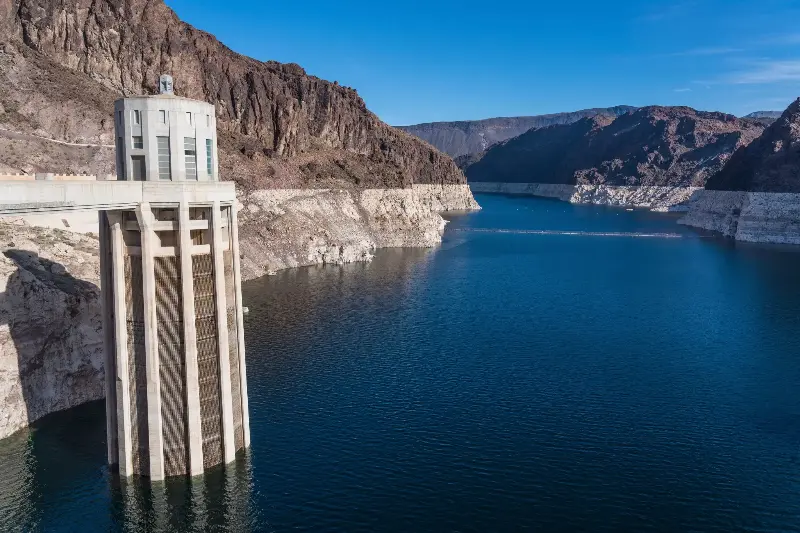

Hoover Dam prepares stress test as Lake Mead declines
- Reclamation will test the limits of 12 turbines below Lake Mead’s 1,035-foot threshold, with restricted hours, close monitoring and inspections.
- Lake Mead stood at 1,041 feet after a 1,037-foot low; pressure below 1,035 feet may damage older blades, while newer units can run to 950.
- 40 million people in seven states and Mexico depend on Colorado River water; experts say supply outranks power, and basin states face use cuts. Read more
The Hoover Dam is being prepared for a first-of-its-kind stress test that could help officials estimate how long the aging facility’s hydropower turbines can continue operating if water levels in Lake Mead keep falling.
A spokesman for the Bureau of Reclamation, which runs dams and reservoirs across the West, told Newsweek it had developed a testing plan for the site.
These tests aim to establish the limits of 12 of the site’s 17 hydropower turbines when water levels in Lake Mead fall below an elevation of 1,035 feet–a major threshold for the dozen older turbines.
As of Wednesday, the water level sits at 1,041 feet. It fell to its lowest level, 1,037 feet, on October 22.
What Is Happening?
“Reclamation has developed a comprehensive testing plan to more precisely determine the operating limits of the older hydropower generating units below 1,035 feet,” Reclamation Press Secretary Mary Carlson told Newsweek.
She added: “Under this testing plan, Reclamation will continue operating the older turbines below 1,035 feet, but only with strict limits on operating hours, enhanced monitoring, and frequent inspections to ensure safe performance.
“The testing results will clarify the shutdown elevation and give Reclamation a more accurate picture of the facility’s capacity as reservoir levels decline.”
When asked by Newsweek when the test might take place, Carlson said: “The reservoir has not yet reached the water level where the testing may be performed.”
Why It Matters
Hoover Dam is one of the most recognizable pieces of infrastructure in the United States. Beyond supplying electricity, it plays a central role in managing water resources across a number of states in the Colorado River Basin.
The hydropower it creates helps power thousands of homes, tribal communities and businesses across the Southwest.
However, hydropower production can only be generated if there is sufficient water pressure flowing through the turbines.
Water enters through four intake towers in Lake Mead before falling down giant pipes to the powerhouse at the base of the dam, where the turbines are located.
As the water level drops, the weight of the water pushing down the pipes decreases. Below the 1,035 feet threshold, low water pressure could cause air bubbles to form and damage the turning blades.
The newer turbines are capable of generating power even at lower water pressure, down to water levels of 950 feet.
Federal officials insisted that safety would remain a priority when the stress test for the older turbines takes place.
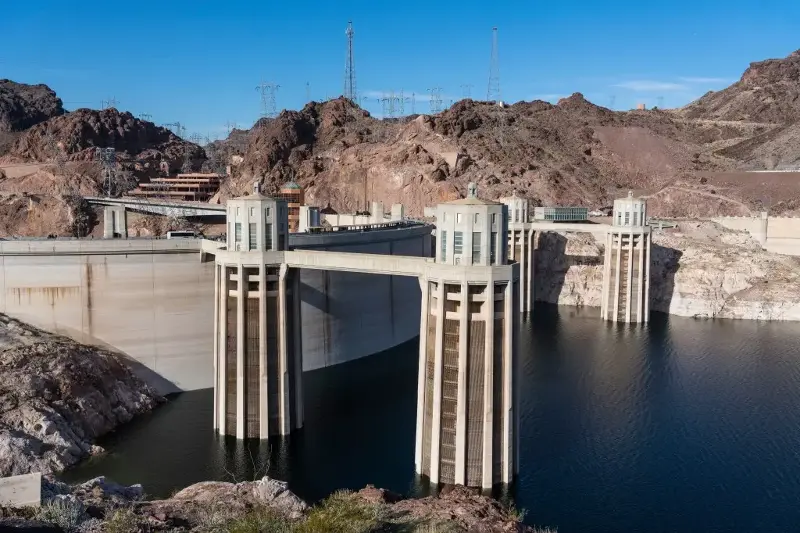
Beyond the power it generates, roughly 40 million people across seven states and Mexico rely on Colorado River water.
“Water levels in both Lake Mead and Lake Powell are hovering at or near historic lows,” Kathryn Sorensen, director of research at Arizona State University’s Kyl Center for Water Policy, told Newsweek.
She continued: “Fall rains gave us some relief in Lake Powell, but both reservoirs are only about a quarter full. This is very concerning because millions of people and thousands of acres of farmland rely on this water.”
Hoover Dam Power
Hydropower is traditionally one of the lowest-cost sources of electricity in the West, but during times of water shortages, energy might be supplemented by other means.
According to a recent Energy Information Administration (EIA) forecast, hydropower will account for about 4 percent of the Southwest’s electricity generation mix in 2026, down from a peak of 8 percent in 2011.
Total hydropower generation in the region is expected to reach 6.13 billion kilowatt-hours (BkWh) this year, roughly 9 percent lower than in 2025.
Hydroelectric power generated in the Southwest region was also found by the EIA to be 28 percent below the 10-year average.
Prioritizing Water Supply
While hydropower remains important across the Southwest, Sorensen noted that electricity generation was ultimately secondary to securing water supplies.
“Certainly these entities believe Hoover hydropower is worth generating still, but according to the Law of the Colorado River, water supply needs always trump hydropower,” she said.
As climate pressures, prolonged drought and growing demand continue to strain water supplies, federal and state agencies have introduced measures to cut water-use and stabilize reservoir levels.
The Department of the Interior plans require California, Arizona and Nevada to collectively reduce water consumption by 1.25 million acre-feet annually over the next two years–roughly equivalent to the annual water use of several million households.
“It is absolutely necessary to reduce usage across the entire Colorado River basin to stabilize the reservoirs and protect critical dam infrastructure,” Sorensen told Newsweek. “Current reductions are a stopgap measure that may arrest reservoir declines but are unlikely to significantly rebuild reservoir storage absent very large snowpack and subsequent runoff in the Rockies.”
Despite reaching historic low thresholds, Lake Mead saw a slight bounce in water levels heading into October following storm activity. The EIA said this year’s El Niño weather pattern could bring above-average precipitation to parts of the region, potentially improving water levels further.
However, the agency warned a single wet year was unlikely to make up for years of water scarcity across the Colorado River Basin.
Contact Newsweek editors on this story: Ben Kellyand Cristina Diciu.