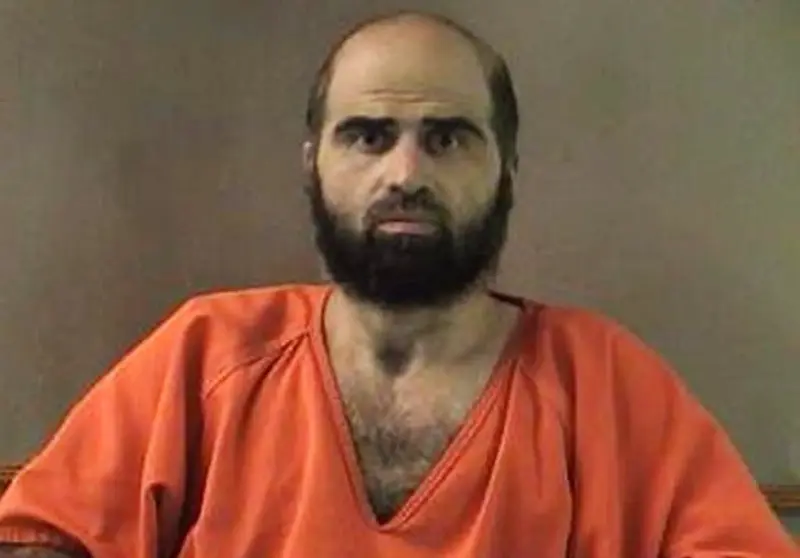

Fort Hood shooter reveals possible defense to fight death sentence
- Hasan asked a Kansas court to postpone his Dec. 3 firing-squad execution, saying he needs time to challenge the sentence on constitutional grounds.
- His filing says the judge barred him from arguing he acted to defend the Taliban against an unlawful U.S. attack, invoking a “defense of others.”
- Trump approved the firing squad on October 2, but plans to livestream it were canceled after objections from victims’ families, leaders and lawmakers. Read more
Fort Hood shooter Nidal Malik Hasan has asked a court to delay his upcoming firing squad execution so he can prepare a petition contesting his death sentence, where he intends to present the argument that his actions were “legally justifiable.”
Hasan, a U.S. Army psychiatrist who held the rank of major, was convicted of killing 13 people and injuring 32 others in a shooting spree at the military base in November 2009.
In a court filing on Tuesday, Hasan said he “intends to demonstrate that the military court’s judgment and his resulting sentence of death were obtained and are maintained in violation of his federal constitutional and statutory rights.” It was filed in the U.S. District Court in Kansas since Hasan is being held at the military prison at Fort Leavenworth.
One of Hasan’s arguments would be that he was barred at trial from presenting the argument that his actions were “legally justifiable because he was defending the Afghan Taliban, who are trying to establish Islam as Supreme Law of their land, from an unlawful attack by the United States Army—in short, ‘defense of others,'” according to the court filing, which Newsweek reviewed.
The filing said that after the judge precluded Hasan from making that argument in his 2013 trial, he was “largely silent” throughout.
The military called some 90 witnesses during the 11-day trial, but Hasan—who presented his own defense—offered only an opening statement and rested his case without calling anyone to testify in his defense or making a closing argument.
According to the court filing, Hasan intends to keep representing himself as he fights the execution, though he is being assisted by lawyers from the American Civil Liberties Union’s Capital Punishment Project.
Newsweek has contacted the ACLU attorney listed in the filing and the Pentagon for comment via emails sent outside regular business hours.
Hasan’s execution has been scheduled for December 3, but his legal challenge now has the potential to cause a delay. A hearing has been set for Wednesday morning.
When Is Nidal Hasan’s Execution?
The Army announced that Hasan’s execution would take place at Fort Hood, Texas, at 1 p.m. Central time on December 3.
Defense Secretary Pete Hegseth and Pentagon officials said the execution would be livestreamed, but President Donald Trump called off that plan following public outcry, including from the families of the victims, retired military leaders and lawmakers on both sides of the political aisle.
Hasan walked into a medical building on November 5, 2009, where soldiers at Fort Hood were waiting to receive medical clearance for deployment. He shouted “Allahu akbar”—Arabic for “God is great!”—and opened fire. He also shot at soldiers fleeing toward the parking lot. Hasan said it was an effort to stop them from going to Afghanistan and killing his fellow Muslims. He is paralyzed from the waist down after being shot in the back by law enforcement, and he now uses a wheelchair.
A military jury convicted Hasan of all 42 counts brought against him in 2013 and sentenced him to death. He acknowledged during his court-martial that he was the shooter and said he had “switched sides.” The Army said Hasan’s appellate process was completed after the U.S. Supreme Court denied his request for review in March 2025.
Trump approved the execution by firing squad on October 2, giving the Army authority to set the date. The decision came days after Tennessee’s failed attempt to execute Christa Pike brought fresh scrutiny on how states carry out the death penalty, particularly when using lethal injection.
The military hasn’t executed a service member by firing squad since World War II. The last military execution took place on April 13, 1961, when Army Private John Bennett was executed by hanging.
‘A Political Production’
The Reverend Jeff Hood, who has served as a spiritual adviser to more than a dozen inmates who have been executed and has warned against the use of firing squads, told Newsweek on Wednesday that it was always clear that Hasan could seek to delay his execution and thwart the Trump administration’s plans.
“The Trump administration has spent weeks turning Nidal Hasan’s execution into a political production. There were announcements, threats of spectacle, talk of livestreaming a man’s death and all the chest-thumping about America’s willingness to kill,” he said.
Hood continued: “Yet anyone familiar with the federal death penalty process understood that a habeas corpus petition could bring the entire timetable to a halt. Now that is precisely where the case stands.
“The administration has discovered that executions are not campaign rallies, and that the machinery of government cannot simply be commanded to produce a death on a political schedule.”
Contact Newsweek editors on this story: John Fitzpatrick and Shakeema Edwards.