
California’s New Child Seat Belt Law: Five-Step Test Explained
- From Jan. 1, 2027, children ages 8–16 must pass a seat-belt fit check to use belts; those who fail must stay in a booster or other restraint.
- Children under 8 still need a rear-seat car or booster seat; violations can bring $100 base fines, rising to $250, plus fees and a driver-record point.
- Katie Miller argued that extra seat rules complicate motherhood and could affect family size; reactions were mixed, with many rejecting her claim. Read more
California is preparing to introduce new child passenger safety requirements, with drivers facing fines if young passengers are not properly restrained.
The new rules, which take effect on January 1, 2027, will require children aged 8 to 16 to meet five specific criteria before they can legally travel using a standard seat belt.
The bill was signed into law by Governor Gavin Newsom in October 2025. It updates California’s Vehicle Code to make the five-step seat belt fit test the standard for determining whether a child is properly restrained by a safety belt.
What Is California’s New 5-Step Seat Belt Test?
To determine whether a child can safely use a standard seat belt, parents should check that they meet all five requirements. The five criteria are:
- Back against the seat: The child must be able to sit all the way back against the vehicle’s seat.
- Knees over the edge: Their knees must bend comfortably over the edge of the seat.
- Shoulder belt position: The shoulder belt must fit snugly across the middle of the child’s chest and shoulder, rather than resting against their neck.
- Lap belt position: The lap belt must sit as low as possible, touching the child’s thighs.
- Remaining seated: The child must be able to maintain this position throughout the entire journey.
The test is designed to assess whether a vehicle’s seat belt fits a child correctly, rather than relying on age or height alone.
Newsweek contacted the National Highway Traffic Safety Administration (NHTSA) and the California Highway Patrol (CHP) via email on Thursday for comment.
Who Will Be Affected by the New California Car Seat Laws?
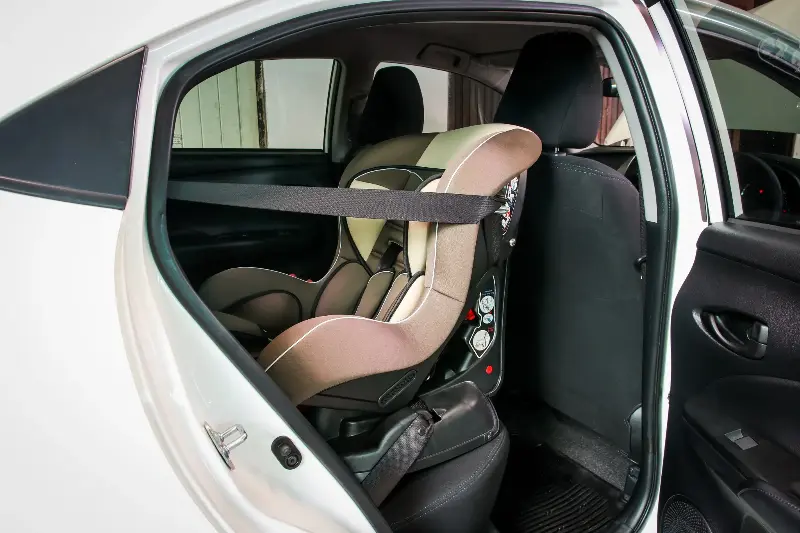
Children who cannot pass all five steps must continue using an appropriate child passenger restraint system, such as a booster seat. Those who pass the test can transition to a standard seat belt without one.
The rules do not mean that every child in this age group must use a booster seat. Those who pass the test can use a standard seat belt without one.
Existing requirements for younger children remain in place. Children under 8 must generally be secured in a car seat or booster seat in the back of the vehicle, while children under 2 must ride in a rear-facing car seat unless they meet specified weight or height exemptions.
California Highway Patrol advises parents not to rush children through the different stages of car seat use, recommending that they remain in each stage for as long as possible.
CHP also provides child car seat safety guidance on its website, including advice on proper installation and information on finding a local child passenger safety technician for assistance.
How Much Could Parents Be Fined?
Drivers and parents could face financial penalties if children are not properly secured in a vehicle.
Violations carry a base fine of $100 for a first offense and $250 for subsequent offenses, according to the California Family Law Guide website. After mandatory penalty assessments and court fees are added, the total for a first violation can exceed $500. A conviction can also result in one point on the responsible driver’s record.
Katie Miller Criticizes California’s New Car Seat Requirements
The new legislation has prompted a reaction from conservative political commentator Katie Miller, wife of senior White House chief of staff Stephen Miller, who questioned the impact of additional car seat requirements on families and birth rates.
In a post on X, Katie wrote: “The fastest way to kill the birth rate is mandating more car seats.”
She continued: “Car seats make motherhood significantly more complicated and difficult, from vehicle width and anchors to traveling with them.”
Miller also suggested that car seat requirements could influence decisions about having more children saying: “I’m not alone in saying that a limiting factor on the number of children we have is car seats.”
Her comments prompted mixed reactions online, with many users disagreeing that car seat requirements are a significant reason why people choose not to have more children.
Newsweek contacted Miller via online form on Thursday for comment.