
First images reveal results of NASA’s asteroid-smashing mission
- Hera images show DART flattened a side of 151-meter Dimorphos, creating a crater with a cigar-shaped feature near its center.
- The impact left Dimorphos tumbling wildly, while Hera found hundreds of boulders, some meters wide, circling the pair and complicating its approach.
- Hera will probe Dimorphos' interior and debris, test impact models, and show how rock and dust amplified DART's push to guide asteroid-deflection plans. Read more
The first detailed images showing the aftermath of a NASA spacecraft deliberately smashing into an asteroid have revealed a huge crater, a dramatically altered surface, and hundreds of boulders flying around the asteroid system.
What Did NASA’s DART Mission Do?
NASA’s Double Asteroid Redirection Test, or DART, intentionally crashed into the small asteroid Dimorphos on September 26, 2022, in the world’s first test of technology designed to deflect an asteroid.
To make it clear, neither Dimorphos nor the larger asteroid it orbits, Didymos, pose a threat to Earth; NASA’s mission was to establish whether deliberately hitting an asteroid with a spacecraft could change its path, a technique that might be used one day if scientists do discover a dangerous asteroid heading toward Earth. The idea is that a relatively small change to an asteroid’s speed, made far enough in advance, could eventually cause it to miss the planet.
NASA Administrator Bill Nelson said, “At its core, DART represents an unprecedented success for planetary defense, but it is also a mission of unity with a real benefit for all humanity.”
And the experiment worked.
Before the collision, Dimorphos took about 11 hours and 55 minutes to orbit Didymos. NASA confirmed that after DART struck, its orbit had slowed down by roughly 32 minutes, showing that humans can deliberately change an object’s motion in space.
But telescopes observing the asteroids from afar couldn’t provide a complete picture of what the collision had actually done to Dimorphos itself.
What Do the First Images of Dimorphos Show?
Now, four years later, the European Space Agency’s (ESA) Hera spacecraft has arrived at Dimorphos to investigate.
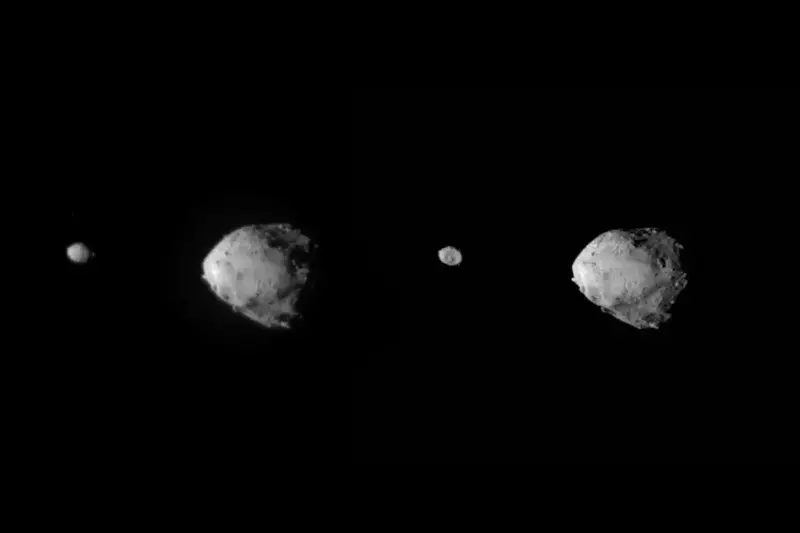
The first detailed images reveal that DART did far more than simply alter Dimorphos’ orbit.
The impact flattened one face of the roughly 151-meter-wide asteroid, producing what the ESA described as a crater the size of a “sports stadium” that extends across the entire width of that side of the asteroid.
“Scientists debated whether Dimorphos had sustained an impact crater, changed its shape, or stayed the same,” Hera principal investigator Patrick Michel said. “Much to our surprise, the answer turns out to be all three at once! The face struck by DART has been flattened into an impact crater the size of a sports stadium, which extends across the asteroid’s entire width.”
Michel told Newsweek that scientists had expected DART to either produce a relatively small crater or to extensively reshape Dimorphos. Instead, they found elements of both. “The crater is so large, essentially the size of the asteroid, that while it is clearly visible as a crater, it also changed substantially what Dimorphos looks like,” he said.
One of the newly released images, taken by Hera’s Asteroid Framing Camera from a distance of 29 kilometers on November 7, shows both Didymos and Dimorphos.
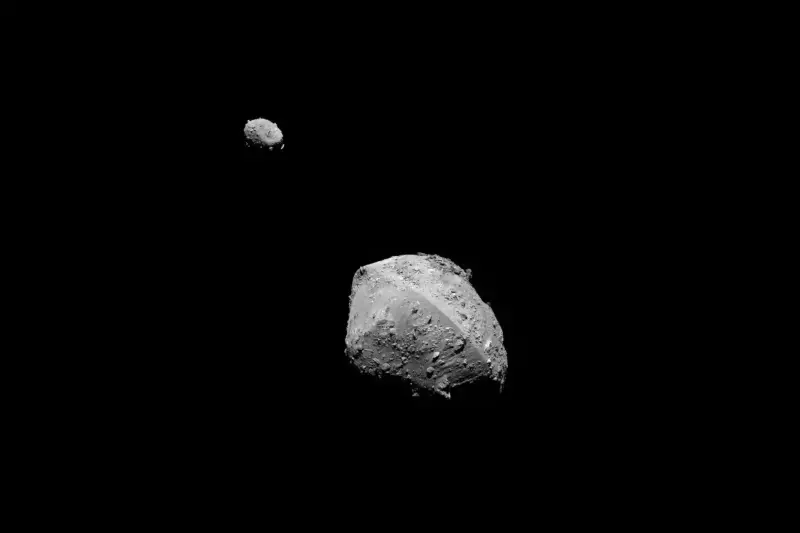
The DART impact site can clearly be seen on Dimorphos, with one side (top left) appearing flattened.
ESA said the images also reveal unusual features within the crater, including what appears to be a cigar-shaped structure at its center.
Despite the dramatic damage at the point of impact, the rest of Dimorphos appears comparatively unchanged. ESA said that the “boulder fields covering its other regions look just like they did in DART’s 2022 images.”
But Michel cautioned against drawing conclusions yet about how localized the effects of the collision were. “It is too early to say,” he told Newsweek. “We are still trying to make sure we understand what we see, and then explain how it is possible, which effectively relates to the structure of the asteroid.”
Researchers have, however, discovered another major change: Dimorphos is now “tumbling wildly” as it travels around Didymos.
“As Hera returned more images, it became clear that the DART impact has left Dimorphos tumbling wildly in its orbit,” ESA Hera mission scientist Michael Kueppers said.
Newsweek has reached out to Kueppers for comment.
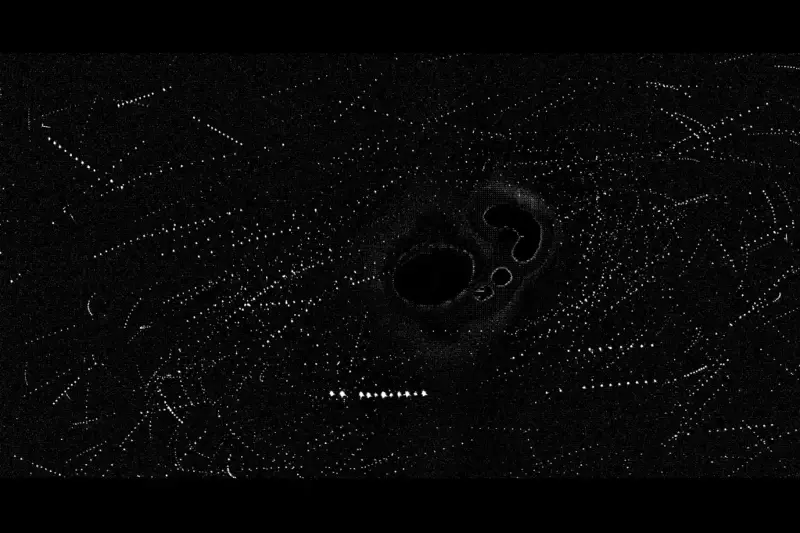
Hera has also spotted hundreds of previously unknown boulders, some only a few meters wide, orbiting around the two asteroids. The finding was described as another “big surprise” by the team and could affect how the mission is managed as the spacecraft gets closer to the pair of asteroids.
Why Do the Findings Matter?
Observations from Earth allowed scientists to measure how much DART changed Dimorphos’ orbit, but they couldn’t reveal in detail what had happened to the asteroid’s surface or interior.
Michel told Newsweek that understanding those physical changes is important because scientists need to test whether their computer models can accurately reproduce what actually happened when DART struck.
“What is the outcome of the DART impact on the surface of Dimorphos?” Michel said. “Do they need to reproduce a crater, and in this case, what is the size and depth of the crater they need to reproduce? Do they need to reproduce a shape change and other characteristics?”
Proving that DART was capable of changing the path of an asteroid was only part of the experiment. Researchers also need to understand why the impact produced the amount of movement that it did, and how factors such as an asteroid’s structure and the material thrown off during a collision affect the result.
NASA previously found that DART’s collision threw large amounts of rock and dust from Dimorphos into space. As that material was blasted away, it gave the asteroid an additional push, increasing the effect of the collision.
Hera will now help scientists understand exactly how DART changed Dimorphos, so they can better predict how the same approach might work on other asteroids.
“NASA’s DART mission demonstrated that we can change an asteroid’s orbit. Hera is now revealing what happened to the asteroid itself,” Hera mission manager Ian Carnelli said. “By combining these two missions, humanity is taking a decisive step towards making asteroid deflection a reliable tool for protecting our planet.”
Hera’s investigation is only just beginning. The spacecraft is expected to move closer to the asteroid pair in December, allowing it to take much sharper images.
Among the biggest questions Michel said scientists now hope to answer are why DART produced such a large crater without substantially changing the rest of the asteroid, what Dimorphos is like inside, and why so many boulders are still moving through the system. “Why is there still so many flying boulders in the system, which was a big surprise and source of excitement of the science team?” Michel said.
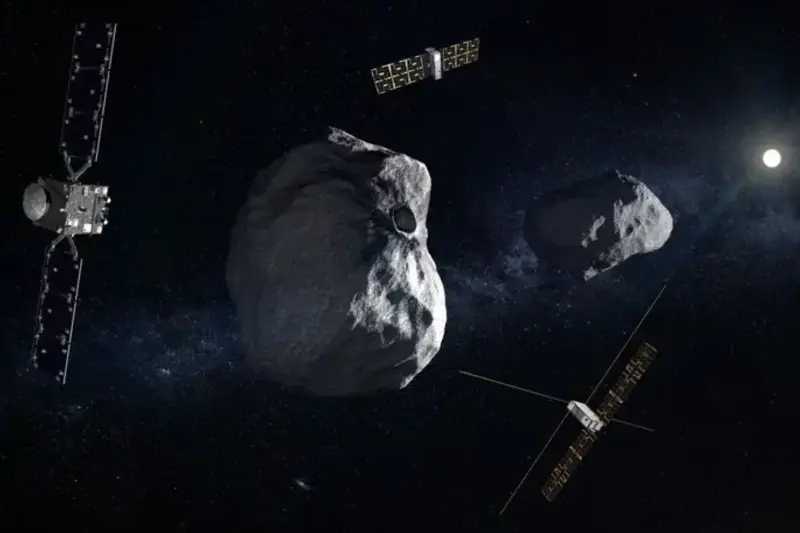
In January 2027, it’s scheduled to release two small satellites, Juventas and Milani, which will carry out further investigations, including studying Dimorphos’ interior and the material and dust around the asteroids.
Newsweek’s reporters and editors used Martyn, our AI assistant, to produce this story. Learn more about Martyn here.
Contact Newsweek editors on this story: Ben Kelly and Emma Lee-Sang
Update 11/26/26, 8:04 a.m. ET: This article was updated with comment from Patrick Michel.