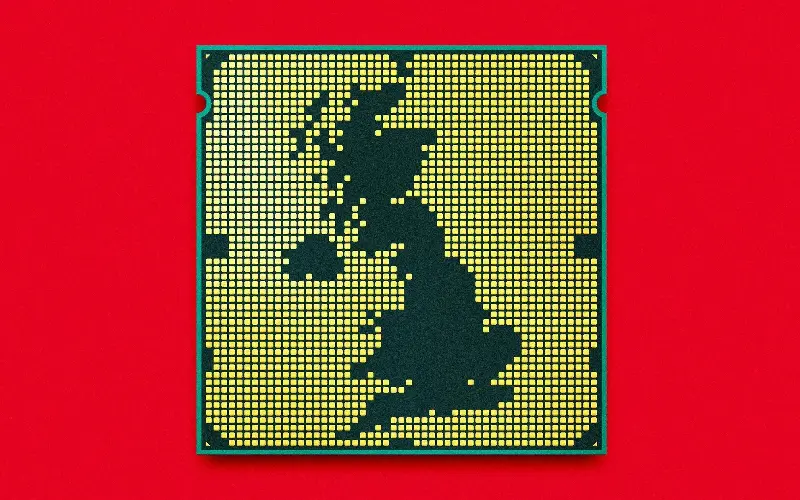

The British chip champions challenging Nvidia’s AI stranglehold
- UK chip start-ups like Fractile and Olix are emerging as challengers to Nvidia, raising significant funding and developing innovative technologies.
- Fractile aims to enhance AI chip performance by stacking memory and processors in 3D, while Olix is exploring photonic chips for faster data transfer.
- Despite fierce competition from US firms, UK companies may benefit from a shift towards diverse suppliers in AI, especially amid geopolitical tensions. Read more
One of the most eye-popping numbers revealed during Anthropic’s $2tn (£1.5tn) float was its gargantuan spending plans.
The Claude-maker disclosed it intends to spend some $1tn across data centres and AI chips to power its race to superintelligence.
At least a portion of that trillion-dollar spending blitz could go towards one British company. Fractile, a new UK chip start-up, is rumoured to have a $250m deal to supply its novel technology to the AI giant.
The computing demands of Anthropic and OpenAI have triggered an arms race across the chip industry, as entrepreneurs seek new breakthroughs in power and efficiency.
“The same way the [AI] labs are racing with each other, chip companies are making a series of bets to push the frontier,” an industry source says.
The UK stands to benefit. In Oxford, Cambridge, London and Bristol, teams of chip designers and young entrepreneurs – some not long out of university – have launched new start-ups hoping to challenge the dominance of Nvidia.
The $3.5tn US giant has long had a stranglehold over AI computing power, with its powerful Blackwell graphics processors filling up data centres around the world.
But now the company is wracked by chaos, opening the doors to challengers to come and take its crown in future.
Jensen Huang, Nvidia’s former chief executive, quit earlier this month after an affair with an alleged Chinese spy before being reinstated on Monday to the shock of Wall Street.
UK chip companies, meanwhile, have enjoyed a bumper year for funding, between them raising well over $1.5bn.
Two names in particular have seen their valuations surge.
Fractile, led by Walter Goodwin, the 30-year-old Oxford robotics expert, raised $220m in May at a $1bn valuation. Venture investors competed to join a further round valuing it at $7bn earlier this month in a deal raising $720m.
Another start-up, Olix, led by 25-year-old James Dacombe, more than tripled its valuation in six months from $1bn to $3.3bn.
Both companies promise their technology will offer an alternative to Nvidia.
They are seeking to break down a so-called “memory wall”, which has limited AI chips.
“Both attack the right problem, memory, from different directions,” says Patrick Moorhead, an analyst at Moor Insights & Strategy.

Fundamentally, most AI systems are split across two types of chip: a graphics processor, typically one from Nvidia, which runs thousands of computations at once, and a memory chip that feeds it data.
However, getting information to flow between the memory chip and the processor has become a bottleneck, limiting speed and efficiency.
It means that despite hundreds of billions being spent on computing power, running a complicated maths problem using AI can take hours or even days because the two chips need to interact with one another.
There are also technical nuances that mean Nvidia’s best chips are better for some AI tasks than others. Its graphics units are less good for so-called “inference”, a technical term for the computing process that occurs when you ask an AI app a question.
According to McKinsey, inference will account for some 60pc of AI computing power by 2030. Analysts at Futurum estimate the semiconductor market for inference will be worth $885bn.
Both Fractile and Olix are seeking to fill this gap of “cheaper, faster, lower-power inference” left by Nvidia, says Moorhead.
Speaking on the No Priors podcast, Goodwin, a star Oxford PhD and college rowing captain, says Fractile is developing a “fundamentally new building block” for “aggressively high bandwidth” from memory chips.
To do this, it is planning to stack the memory components onto the processor in a single 3D chip. It is planning to ramp up production of its chips with Taiwan’s TSMC from next year.
Olix is pursuing a still more radical approach. It is planning to make photonic chips, using light particles, rather than electrons moving through copper, to accelerate the speed that data move across and between chips.
Led by Dacombe, who dropped out of school at 17 and was granted money by Peter Thiel, the American co-founder of Palantir, to pursue his ideas, Olix has been notable for advertising a hard-charging, uncompromising culture.
The start-up bills itself as “high-velocity and high-stakes” and offers to pay staff a bonus if they move within 20 minutes of its office. It will also pay those who do not fit in to leave.
It is not just Fractile and Olix making their mark on the sector.
Salience, an Oxford spin-out led by Vaysh Kewada, raised $125m last month from investors including AMD and Intel. It is developing chips used to connect different processors together – known as switches – using optical parts rather than copper to boost their speeds.
Meanwhile, Callosum, founded by Cambridge researchers, secured $100m over the summer for software that will let different types of processors work seamlessly together.
Yet while these start-ups are brimming with ideas and talent, they face fierce competition.
US companies such as Cerebras have already raised many billions of dollars for inference systems. Nvidia, meanwhile, signed a $20bn deal with US start-up Groq last year for access to technology going after a similar problem.
“Someone is not going to come along and overtake Nvidia any time soon,” says David Harold, a former executive at UK chip company Imagination and an analyst at Jon Peddie Research.

In the past, UK chip companies have often reached a certain scale before being snapped up by a foreign buyer. Arm was bought by Japan’s Softbank in 2016, before listing in the US. Graphcore is also owned by Softbank. Imagination is controlled by Chinese investors.
However, Goodwin argues AI labs are already looking to diversify their suppliers. “There will be a real need for a diversity of supply as something like compute becomes existential,” he said earlier this month. US labs will also be looking for “premium capability, premium intelligence”.
“The trend that we’re seeing is one towards heterogeneity,” adds Kewada. “That does then seed the ground for alternative solutions.”
Harold, meanwhile, notes that being British owned and headquartered could be an advantage.
The US has proved to be an increasingly unreliable ally, while Nvidia’s spying scandal has driven a further wedge between America and China.
Anthropic in particular has been keen to distance itself from any reliance on Chinese technology.
“If I were at one of these companies, I would be trying to stay UK-based, showing it is UK origin technology,” Harold says.
Indeed, one Fractile presentation issues a call to “remake the global AI stack with Europe at its centre”. It has since secured investment from the taxpayer-backed Sovereign AI Fund.
With the world fractured and Nvidia’s future still uncertain, for these British companies, there may never be a better moment to launch their challenge.