


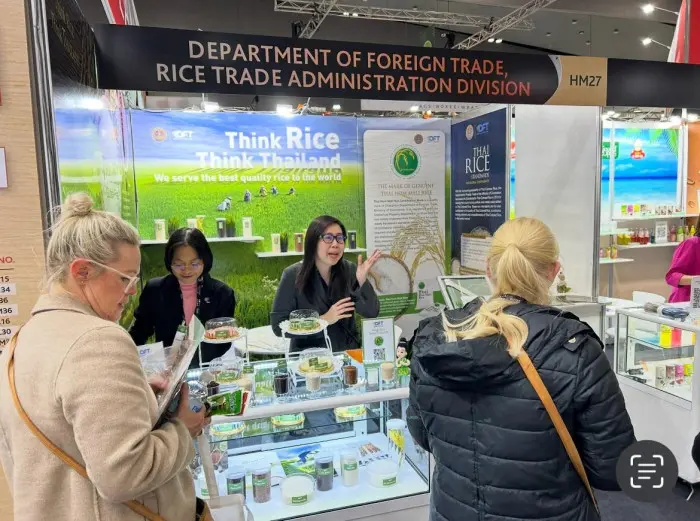
It is too early to assess the potential impact of jasmine rice cultivation in the United States on Thai rice exports to the US, a member of the Thai Rice Exporters Association said.
The USA Rice Federation is promoting domestically grown jasmine rice to meet rising consumer demand and reduce reliance on imports, according to a report by the Thai Trade Centre in Chicago, which cited an article on Farmprogress.com.
The report noted that six US states -- Arkansas, California, Louisiana, Mississippi, Missouri and Texas -- are currently producing jasmine rice.
It estimates that jasmine rice fields in the US have expanded to a record high of 50,000 acres, or 126,400 rai.
Retailers are also shifting their private-label jasmine rice from imported to US-grown varieties. Walmart reportedly announced this move last year, followed by Kroger, the report said.
This is not the first attempt by the US rice industry to compete with Thai Hom Mali rice. In 2009, a new aromatic rice variety called "Jazzman", developed by Louisiana State University, entered the market, according to the Associated Press.
"At this stage, it is too early to determine whether the expansion of jasmine rice cultivation in the US will impact Thai Hom Mali rice exports," said Chookiat Ophaswongse, honorary president of the Thai Rice Exporters Association.
However, he noted that if US farmers succeed in cultivating jasmine rice, Thai Hom Mali rice exports could be affected.
In 2025, Thailand exported 1.76 million tonnes of Thai Hom Mali rice, with 640,000 tonnes shipped to the US, its largest export market, according to the Department of Foreign Trade.
RECOMMENDATIONS
Mr Chookiat identified three factors to monitor: quality, price and consumer preferences.
In terms of quality, he explained that it remains to be seen whether this US-grown rice can match the distinct qualities of Thai Hom Mali rice, such as its aroma.
He added that there is currently limited information regarding plantation locations, climate conditions, soil types and rice cultivars in the US, all of which are crucial determinants of rice quality.
On pricing, he noted the need to compare the price of US-grown jasmine rice with that of Thai Hom Mali rice, which is currently priced at around US$1,200 per tonne.
He also emphasised the need to monitor consumer acceptance as US-grown rice enters the market.
Mr Chookiat explained that in the US, Thai Hom Mali rice is often sold under the name "Thai Jasmine Rice", which is widely recognised by consumers.
However, in areas with large Asian communities, such as Los Angeles and San Francisco, packaging may use the name "Thai Hom Mali Rice" because consumers are more familiar with it.
Regarding the report, he remains sceptical about the data on the acreage of jasmine rice fields in the US.
Mr Chookiat stressed that the Commerce Ministry should conduct a thorough investigation to verify key details, including the locations and sizes of the plantations.
He also urged the government to continue promoting Thai Hom Mali rice internationally and to educate younger consumers about its unique qualities.
He cited Thailand's loss of market share in China as an example, noting that lower-priced Cambodian "Pkha Malis" rice, at around $810 per tonne, has become more popular among buyers.