


AI is making threats faster, while approval delays, data silos, and disconnected teams are slowing defenders down
An organization that can’t coordinate a human response in a day will struggle to govern autonomous agents that act in seconds. New research from Cisco finds that the organizations best at defense do not rely on one strength. They combine broad coverage, fast response, and a team working as one, without operational bottlenecks.
KEY TAKEAWAYS
- AI is raising the stakes. In the Philippines, 93% of organizations suffered a material, business-disrupting cyber incident in the past 12 months. Nearly half were involved in an AI-enhanced attack.
- The biggest blocker is organizational, not technical. Asked what would most improve their defenses, around six in ten practitioners globally who said they are struggling pointed to organizational capabilities, such as coordination, approvals, and access to data, rather than technology.
- The best defenders organize better. Among organizations that increased security spending, Relentless Defenders, the top 8% globally, were nearly twice as likely to see incidents fall (71% versus 39%).
HOW THE PHILIPPINES SCORED
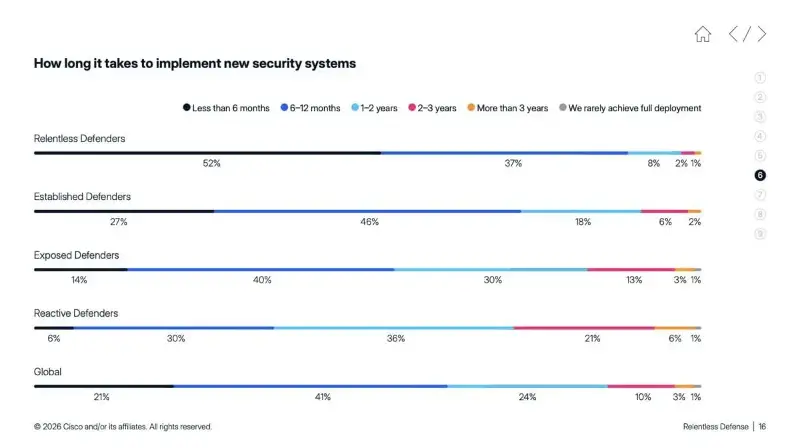
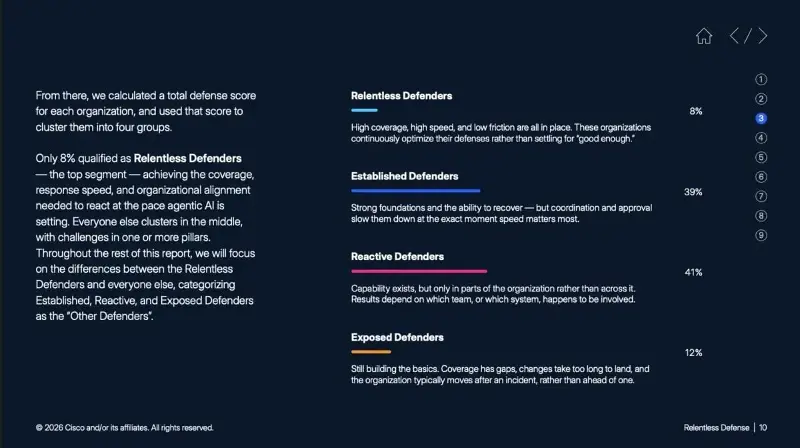
The Relentless Defense Report examines how security practitioners are adapting to a threat landscape being reshaped by AI. The report scored organizations on how completely they can protect their environment; how quickly they can detect, respond to, and remediate a threat; and what slows them down. The average score in the Philippines is 70 out of 100. Seventeen% of organizations in the Philippines fall into the best-performing group Cisco calls Relentless Defenders, compared with just 8% globally.
The question, however, is whether organizations in the Philippines can maintain that lead as the threat environment becomes faster and more complex.
“AI has fundamentally raised the stakes for cyber defense. In a post-Mythos era, the speed of defense is driven by operational agility, not technology alone. The organizations that stay ahead will be those that embed security into how they operate, treat it as more than a compliance exercise, and break down operational silos so the right people can make the right decisions at the right time,” said Zaza Soriano-Nicart, managing director of Cisco Philippines.
WHERE SECURITY TEAMS LOSE TIME
The report identifies organizational friction as a key barrier to stronger cyber defense. But friction is not something security teams can solve alone. Ownership, approvals, and silos sit across IT, procurement, and executive leadership, which is why they persist. And when teams can’t act as one, decision rights are unclear and data is fragmented, making AI deployment and governance increasingly complex.
- Coordination: Only 41% of organizations in the Philippines say security, networking, and IT teams operate as one team with shared visibility and tooling.
- Executive influence: 53% say what they measure is too technical to persuade executives, 28% struggle to translate business metrics into information that can influence decision-making, and 13% have no consistent way to measure security performance.
- Data access: 32% in the Philippines also spend more time collecting and correlating data across systems than addressing the actual threat, and 37% say critical insights are missed because data sits out of reach.
AI IS MAKING DEFENDERS FASTER, BUT SECURITY CONCERNS DELAY ADOPTION
More than nine in ten Filipino practitioners report detection and response gains of at least 25%, and more than one in three say AI is significantly reducing operational burden.
Adoption is gaining momentum, with more than half of organizations having extensively deployed AI-powered security capabilities. Adoption is highest in data security and privacy, and lowest in Security Operations for Investigation, the areas where AI could most directly reduce the burden on security teams. However, only 42% have extensively deployed AI agents in security operations. They are held back by concerns over data exposure, compromised systems, and third-party handling. Only 59% are very confident they could detect and respond to a compromised AI agent.
WHAT RELENTLESS DEFENDERS DO DIFFERENTLY
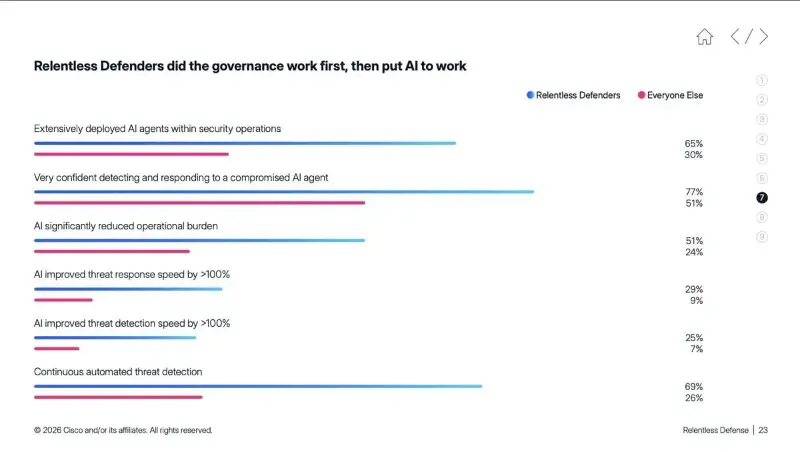
Globally, Relentless Defenders do more to reduce friction and control the AI they are developing. They are also more likely to report stronger AI outcomes in security operations, not because they spend more, but because they lead across the organizational dimensions that enable security teams to act quickly:
- 83% operate as a single coordinated security team with shared visibility and tools across security, network, and infrastructure, versus 37% of all other defenders.
- 86% apply consistent controls to AI agents and non-human identities, versus 37%. 77% are very confident they could detect and respond to a compromised AI agent, versus 51%.
- 25% report AI helped improve threat-detection speed by more than 100%, versus 7%.
Among organizations that increased security spending, Relentless Defenders were nearly twice as likely to see incidents fall (71% versus 39%).
ABOUT THE REPORT
The Relentless Defense Report draws on a double-blind survey of 8,000 security professionals across 30 markets, conducted in April and May 2026. It scores organizations across coverage (how completely they can protect their environment), speed (how quickly they can detect, respond to, and remediate threats), and friction (what slows them down). Analysis was carried out by independent third party Satori Experience.
For more, see the microsite or read the full Relentless Defense Report.