



With the wedding season set to begin with Dev Uthani Ekadashi this Friday, 20 November, many households are looking to buy gold jewellery.
At the same time, many households may want to repurpose their old gold jewellery. With changing designs and preferences, they have two options: exchange their old jewellery for new pieces or remodel existing ornaments into new designs.
But which option is more cost-efficient, and what charges are involved in each? Here's what you need to know.
What is the difference between gold exchange and remodelling?
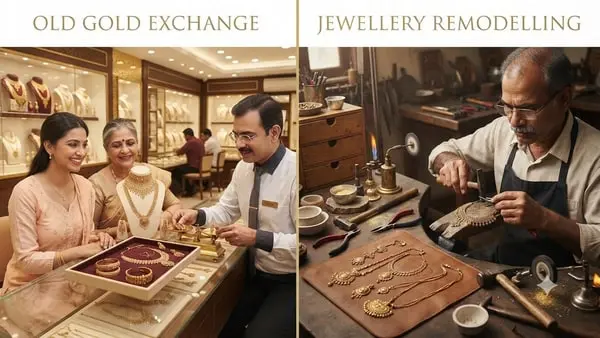
In an exchange, you take old or broken gold jewellery to a jeweller, who tests its purity, weighs it, and credits its gold value towards a new showroom piece. Deductions may apply for non-gold components such as stones and enamel.
In remodelling, the existing jewellery is melted down and crafted into a new design using the original gold.
According to Amit Modak, Director of P. N. Gadgil & Sons, exchange involves paying the difference in gold value and making charges for the new design.
In remodelling, customers pay for additional gold, if required, along with labour and remaking charges. Melting loss may apply during melting and finishing, and the process takes longer due to manufacturing requirements, he added.
What charges are involved in gold exchange and remodelling?
Modak said regular gold jewellery transactions generally attract 3% GST on the jewellery value, while separately billed making charges are subject to 5% GST. However, the applicable tax treatment may vary depending on how the transaction is structured and invoiced.
In remodelling, GST depends on whether the transaction is treated as a jewellery sale or a job-work/service transaction, with the latter potentially attracting GST of around 18%.
Modak highlighted that there are differing interpretations regarding GST on old gold exchange. Some interpretations suggest that GST applies only to the additional gold value, while others consider the full value of the new jewellery as the taxable supply, with the old gold treated as consideration.
Similarly, remodelling customer-owned gold may be treated as a service transaction, with GST depending on the contractual arrangement and tax classification. Customers should therefore ask for a detailed tax invoice explaining the GST calculation before finalising the transaction, he added.
Which option costs less: Gold exchange or remodelling?
Modak explained the cost difference through an example. Suppose a customer wants to purchase an 80-gram 22K gold jewellery set and has 50 grams of old gold jewellery to reuse.
Assumptions for calculation:
- 22K gold rate: ₹13,000 per gram
- Old gold available: 50 grams
- New jewellery required: 80 grams
- Making charges: 12% of gold value
- Old gold valuation: Full value, without deductions
- Melting loss: Nil
The 80-gram jewellery set costs ₹10.40 lakh (80 × ₹13,000), with making charges of ₹1.24 lakh (12% of the gold value), taking the total cost to ₹11.64 lakh.
After deducting ₹6.50 lakh for the old gold (50 × ₹13,000), the balance payable is ₹5.14 lakh before GST, comprising ₹3.90 lakh for the additional 30 grams of gold and ₹1.24 lakh in making charges.
Under the assumption that GST applies only to the balance after adjusting old gold, exchange is the cheaper option at ₹5.30 lakh. If GST applies to the full value of the new jewellery, the exchange cost rises to ₹5.49 lakh, making it almost equal to remodelling at ₹5.49 lakh.
The difference between the two exchange calculations is ₹19,500, arising solely from the different GST bases.
Therefore, customers should not decide purely on the basis of an advertised exchange or remodelling offer. The final invoice and tax calculation are what matter. Compare the making charges and applicable taxes before deciding which option is more economical, Modak added.
Disclaimer: This is for informational purposes only. Choose an option based on your budget, preferences and financial goals.