



Amazon has announced plans to invest an additional $7 billion in renewable energy projects in India by 2030, taking its total planned and contracted investments in the country's clean energy sector to more than $11 billion.
The latest commitment comes on top of the $4 billion the e-commerce major has already contracted in renewable energy investments in India, positioning it among the country's leading corporate purchasers of carbon-free electricity.
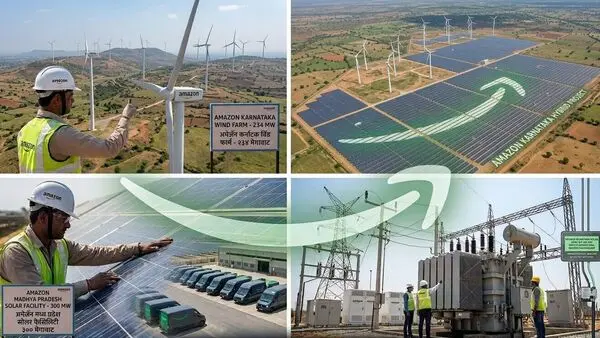
As part of its existing investment commitments, Amazon has also announced four new utility-scale wind and solar projects with a combined generation capacity of 934 megawatts (MW) across Karnataka, Madhya Pradesh and Rajasthan.
The projects include a 234 MW wind farm in Karnataka, Amazon's largest contracted wind project in Asia so far, and a 200 MW hybrid wind and solar project in the state. The other two projects comprise a 300 MW solar facility in Madhya Pradesh and a 200 MW solar project in Rajasthan.
These projects have been secured through long-term power purchase agreements (PPAs), under which companies agree to purchase electricity generated by specific renewable energy facilities.
Once operational, Amazon's contracted renewable energy projects in India will have a combined capacity of more than 2 gigawatts (GW), enough to generate electricity equivalent to the annual consumption of over 3.5 million Indian households.
Amazon's renewable energy footprint in India: Key numbers
Amazon's renewable energy portfolio in India currently comprises 57 projects, including 14 utility-scale wind and solar projects that supply carbon-free electricity to the grid and 43 on-site solar installations across its facilities.
The company's latest $7 billion investment commitment is part of its broader global sustainability strategy. Amazon has set a target to reduce the carbon intensity of electricity powering its operations by 65% by 2030, compared with its 2019 baseline.
The target means that every unit of electricity consumed by the company will be associated with 65% fewer carbon emissions. It is also part of Amazon's broader ambition to achieve net-zero carbon emissions by 2040 under its Climate Pledge.
"Our renewable energy investments in India reflect years of sustained effort, planning, and collaboration across the industry. This additional investment of $7 billion underlines our long-term commitment, helping bring additional wind and solar capacity online while contributing to India's energy security and long-term renewable energy ambitions," said Kara Hurst, Amazon's chief sustainability officer.
“We welcome Amazon’s continued investment in renewable energy in India. Such investments play an important role in advancing India’s clean energy ambitions, strengthening energy security, and supporting sustainable economic growth,” said Pralhad Joshi, hon’ble union minister for new and renewable energy, education, consumer affairs, and food and public distribution.
"They also demonstrate the growing confidence of global companies in India’s renewable energy sector and its potential to attract long-term investment, create economic opportunities, and accelerate the country’s energy transition. We look forward to continued collaboration with industry to advance India’s renewable energy goals.”
Amazon's other sustainability initiatives in India
Beyond renewable energy, Amazon is expanding its sustainability initiatives across electric mobility, water conservation and packaging.
In electric mobility, the company has deployed more than 15,000 electric vehicles across over 500 cities in India. It is also collaborating with Tata Motors to deploy 3,000 electric trucks, which would constitute the largest planned electric truck fleet by an e-commerce company in the country.
On water conservation, Amazon achieved water-positive status in India in 2025, two years ahead of its 2027 target. The company said it returned more than 120% of the water consumed across its direct operations to local communities and watersheds.
It has committed more than $6 million towards water stewardship initiatives in India. These projects are expected to replenish over 4 billion litres of water annually and benefit local communities.
In packaging, more than 50% of Amazon's customer orders in India are now shipped in reduced or original packaging, reducing the use of additional packaging materials.
The company is also working with the Indian Institute of Technology Roorkee (IIT Roorkee) to develop alternative packaging materials using agricultural residue, with the aim of reducing dependence on conventional packaging.