



Unlike classical physics, quantum mechanics generally cannot tell us exactly what will happen in an individual event. Instead, it predicts the probabilities of different outcomes. As one of the theory's early pioneers, Erwin Schrödinger played a key role in debates about what this randomness really means. However, part of his contribution has stayed hidden for more than 80 years.
In a new study posted on the arXiv preprint server, Flavio Del Santo at the University of Geneva has analyzed an unpublished manuscript by Schrödinger, shedding new light on his thinking.
The determinism debate
In a classical event like a coin toss, the result only seems random because we can't measure every force acting on it. Since the early days of quantum mechanics, some physicists have wondered whether quantum randomness works the same way.
In these 'hidden-variable' theories, particles carry unobserved properties that secretly determine the outcome of each measurement. In 1932, however, mathematician John von Neumann published what many took as proof that such properties couldn't exist, and the idea was largely abandoned.
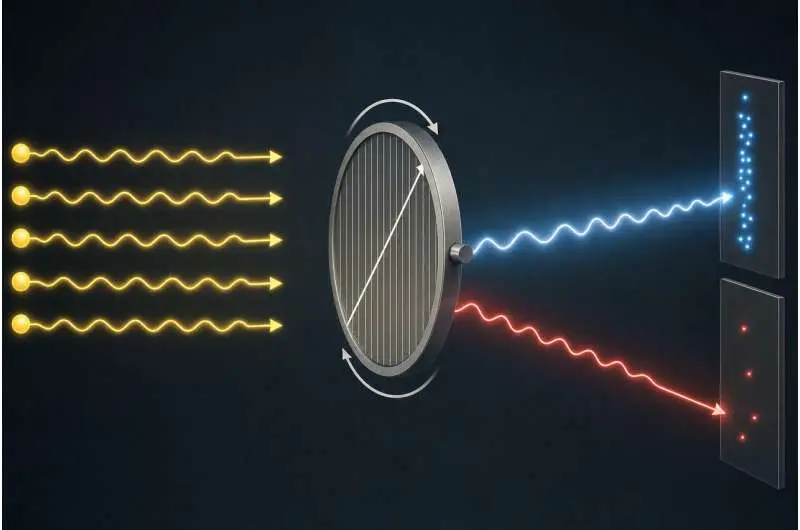
The question resurfaced in the following decade. In 1943, Edmund Taylor Whittaker argued that quantum mechanics had destroyed the classical idea of a predictable universe. To make his case, he imagined particles of light passing through a polarizer: a filter whose orientation determines how much light gets through.
If each particle carried a hidden instruction to pass or be blocked, Whittaker reasoned that rotating the filter after the light had already set off toward it couldn't change these instructions. In contrast, quantum mechanics predicts that the fraction passing through should change.
After Satyendra Nath Bose made a similar case in 1944, the question sparked a lively debate in the journal Nature. Among the responses, Heinrich Pelzer presented a model showing that Whittaker's argument didn't hold up.
Revisiting Schrödinger's manuscript
Although he is often portrayed as a champion of determinism, Schrödinger himself joined the debate. In a three-page, handwritten response, he built his own hidden-variable model, simply to show that such explanations couldn't be ruled out. Crucially, this didn't mean he believed in a fully predetermined universe. As he put it, experiments and logic could never prove either view impossible.
Surprisingly, however, Schrödinger's manuscript never made it to print. Instead, it has sat largely unnoticed in the Schrödinger archive at the University of Vienna. But in his latest study, Del Santo transcribed the work for the first time, using it to reconstruct the debate from other publications from the time.
Rather than the simple 'yes-or-no' instruction Whittaker had assumed, Schrödinger gave each particle of light a hidden property with a whole range of possible values. Del Santo's calculations confirmed that this model matched the predictions of quantum mechanics—and, going a step beyond Pelzer, it still worked when the same light passed through several filters in a row.
Rethinking Schrödinger's contribution
The analysis dates the manuscript to sometime after November 1944 and suggests Schrödinger may have shelved it after learning of Pelzer's work. More importantly, it paints a more nuanced picture of the physicist.
Since the 1920s, before quantum mechanics had even emerged, Schrödinger had suspected that nature's laws might be fundamentally statistical. Ultimately, Del Santo concludes that his model was a proof of principle, rather than evidence of his commitment to determinism.
Written for you by our author Sam Jarman, edited by Gaby Clark, and fact-checked and reviewed by Robert Egan—this article is the result of careful human work. We rely on readers like you to keep independent science journalism alive. If this reporting matters to you, please consider a donation (especially monthly). You'll get an ad-free account as a thank-you.
Publication details
Flavio Del Santo, Schrödinger's unpublished hidden-variable model in the 1944-45 debate over the "Collapse of Determinism", arXiv (2026). DOI: 10.48550/arxiv.2610.20752
Who's behind this story?

Sam Jarman
Science X contributing writer; covers astrophysics, novel materials, medical imaging, and bio-inspired tech. Full profile →

Gaby Clark
MA in English, copy editor since 2021 with experience in higher education and health content. Dedicated to trustworthy science news. Full profile →

Robert Egan
Bachelor's in mathematical biology, Master's in creative writing. Well-traveled with unique perspectives on science and language. Full profile →
© 2026 Science X Network
Citation: Lost Schrödinger manuscript reveals his true view of quantum randomness (2026, October 22) retrieved 22 October 2026 from https://phys.org/news/2026-10-lost-schrdinger-manuscript-reveals-true.html
This document is subject to copyright. Apart from any fair dealing for the purpose of private study or research, no part may be reproduced without the written permission. The content is provided for information purposes only.