



We live in a noisy world. Whether it is the roar of traffic, the rumble of ships or the hum of heavy industry, there is often no escaping noise unless you are a hermit on a desert island.
Noise pollution is already known as a health risk to humans and has been linked to heart attacks, type 2 diabetes and other conditions. But it is also bad news for the animal kingdom, as a new study published in the journal Science reports.
Earlier studies have demonstrated how noise can affect individual animals, causing problems such as stress and changes in communication. What has been missing, though, is a clear understanding of how it affects entire animal populations and food webs.
A closer look at noise pollution
This is where Hansjoerg P. Kunc and Rouven Schmidt at Queen's University Belfast come into it. To try and understand the bigger picture, the two researchers gathered data from 214 experimental studies covering 177 species. This included information on how noise affects body functions, development, behavior, survival and reproduction, abundance, and predator-prey interactions.
They analyzed studies comparing animals exposed to human-made noise with control groups, while accounting for evolutionary relationships among species. This was important because closely related animals often react similarly just because they share a family tree. Kunc and Schmidt needed to make sure those shared traits didn't skew the results.
-
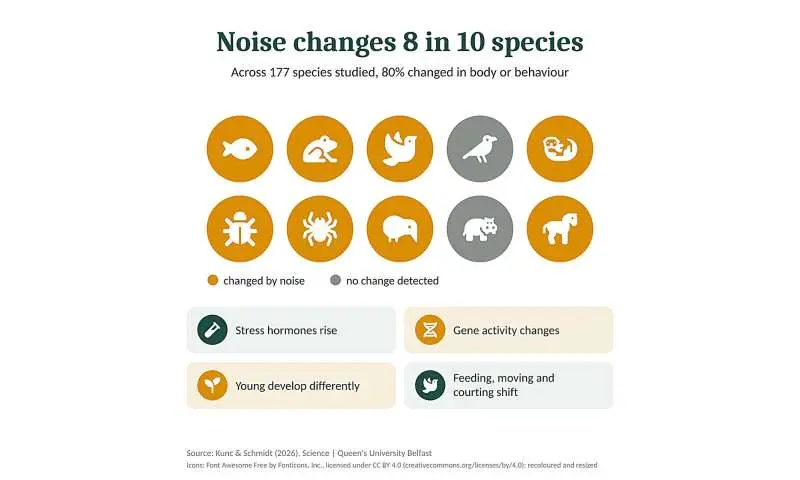
Noise changed the body or behavior of eight in 10 of the 177 species studied. Credit: Hansjoerg Kunc and Rouven Schmidt, Queen's University Belfast -
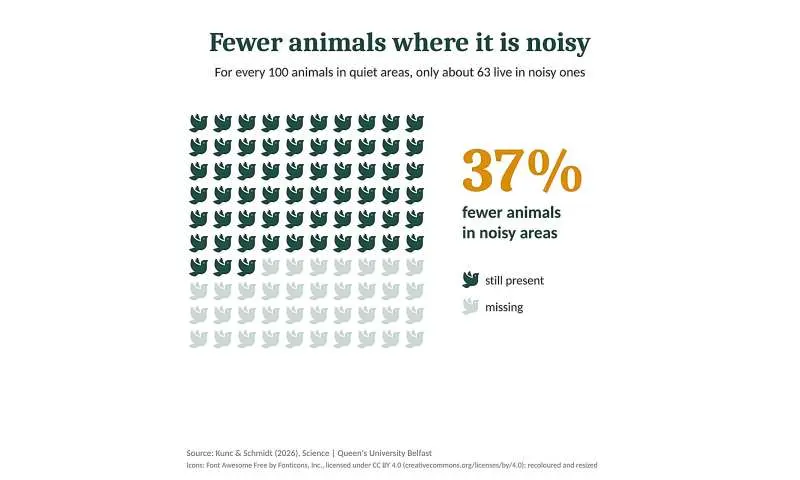
For every 100 animals in quiet areas, only about 63 live in noisy ones: 37% fewer animals. Credit: Hansjoerg Kunc and Rouven Schmidt, Queen’s University Belfast -
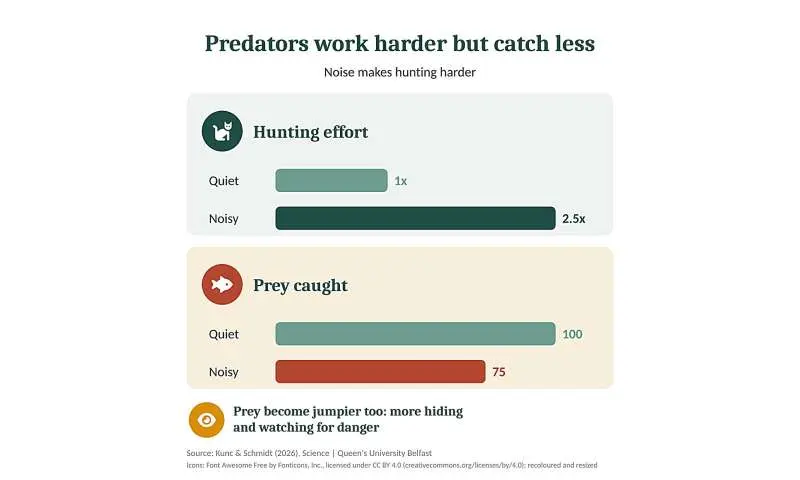
Under noise, predators spent 2.5 times the effort hunting but caught about 25% fewer prey, while prey became more vigilant. Credit: Hansjoerg Kunc and Rouven Schmidt, Queen’s University Belfast -
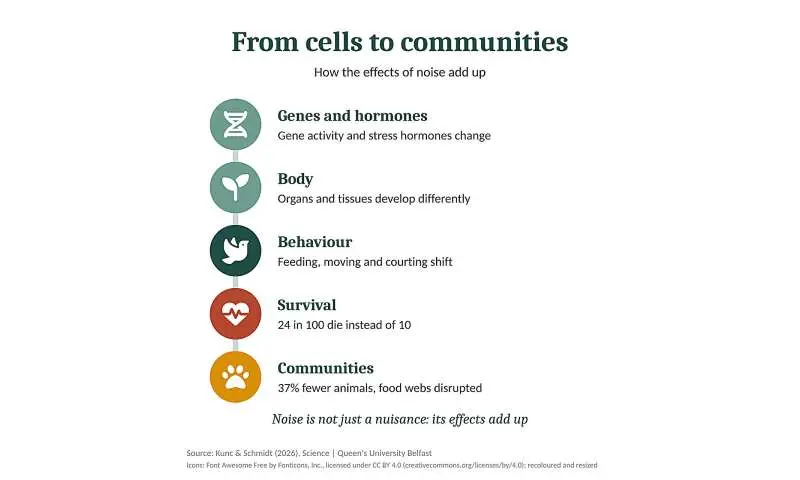
The effects of noise add up, from genes and hormones to survival and whole communities. Credit: Hansjoerg Kunc and Rouven Schmidt, Queen’s University Belfast
Winners and losers
They found that in 80% of the species studied, noise affected at least one aspect of body function, development or behavior. For example, the paper notes that noise can trigger increased cellular stress and elevated stress hormones in animals and alter physical development. But there were some positive findings too.
"These responses can create winners and losers among species, reshaping ecosystem dynamics," wrote the researchers in their study. They explained that these shifts can alter the balance of nature, which could change how different creatures survive and interact in a louder world.
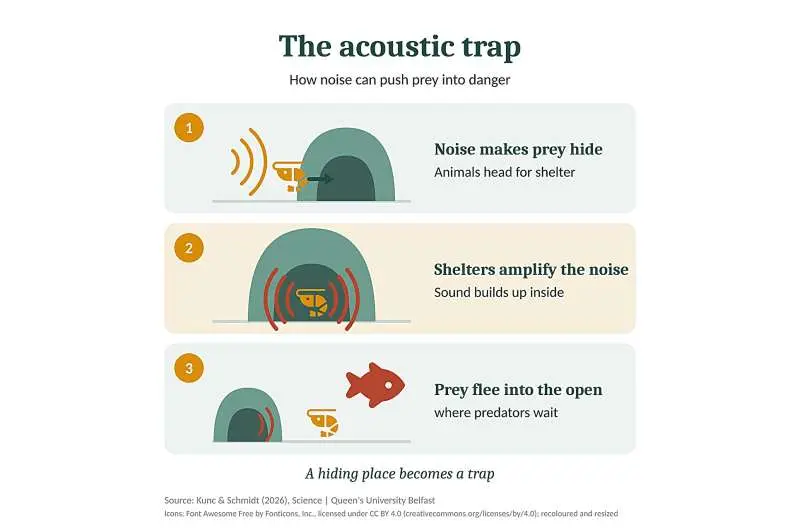
For example, a loser would be a struggling predator missing out on a meal because noise interferes with its hunting success. But a winner could be another predator benefiting when noise drives prey animals out of their shelters and into the open, making them easier to catch.
Despite some advantages, the overall effect of noise pollution on the animal kingdom appears to be a negative one. To tackle this, the researchers point to a possible solution. "Targeted acoustic management such as low-noise zones creating acoustic refugia offers actionable pathways for mitigating these impacts."
Written for you by our author Paul Arnold, edited by Gaby Clark, and fact-checked and reviewed by Robert Egan—this article is the result of careful human work. We rely on readers like you to keep independent science journalism alive. If this reporting matters to you, please consider a donation (especially monthly). You'll get an ad-free account as a thank-you.
Publication details
Hansjoerg P. Kunc et al., Echoes of the Anthropocene: Noise pollution as a global threat, Science (2026). DOI: 10.1126/science.adu9593
Who's behind this story?
Paul Arnold
BSc Biology from University of London. BBC documentary producer with world travel experience. Freelances from southern Spain. Full profile →
Gaby Clark
MA in English, copy editor since 2021 with experience in higher education and health content. Dedicated to trustworthy science news. Full profile →
Robert Egan
Bachelor's in mathematical biology, Master's in creative writing. Well-traveled with unique perspectives on science and language. Full profile →
© 2026 Science X Network
Citation: Noise pollution changes biology or behavior in 80% of animal species studied (2026, November 6) retrieved 6 November 2026 from https://phys.org/news/2026-11-noise-pollution-biology-behavior-animal.html
This document is subject to copyright. Apart from any fair dealing for the purpose of private study or research, no part may be reproduced without the written permission. The content is provided for information purposes only.