



For nearly a century, physicists have relied on the Born rule to calculate the chances of different outcomes when they measure a quantum system. Yet despite decades of effort, nobody has managed to derive the rule from more basic mathematical principles without making assumptions about probability along the way.
Through new analysis published in Physical Review A, Jiaxuan Zhang at the University of Oxford has shown that five of the most prominent derivations of the Born rule all depend on one such assumption. Her work suggests that quantum probabilities can't simply be extracted from a theory that contains none to begin with.
Making assumptions
In quantum mechanics, the state of a system changes smoothly and predictably so long as nobody is looking at it—but the moment it is measured, the result appears to be decided at random. The probability of each possible outcome is supplied by the Born rule.
This awkward contrast sits at the heart of the "measurement problem," one of the deepest puzzles in physics. Because the Born rule is the only place where probability enters quantum theory, many physicists have hoped to derive it from the theory's other, nonrandom rules, instead of simply accepting it as a starting point.
If this derivation is possible, it would show that quantum randomness has a deeper, nonrandom explanation. Many such derivations have been proposed, but each of them has required its own set of assumptions, making it hard to compare them directly.
Additivity and noncontextuality
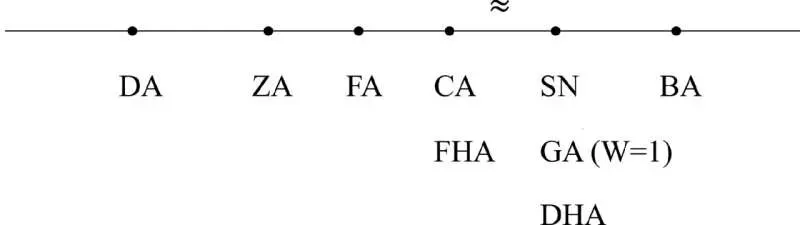
Rather than proposing yet another derivation, Zhang set out to dissect the existing ones. Through a rigorous mathematical analysis, she avoided assuming from the outset that measurements involve probabilities at all. Instead, she simply treated each possible measurement outcome as being assigned a number, then traced the assumptions underlying five major derivations of the Born rule—each of which follows very different lines of reasoning.
In particular, Zhang focused on two assumptions that are often blurred together. First, "additivity" means that the number assigned to "one outcome or another" is the sum of their separate numbers, just as the chance of rolling a one or a two on a die is the sum of each individual chance. Second, "noncontextuality" means that the number given to an outcome doesn't depend on how it is measured, or on what else is measured alongside it.
Rethinking quantum theories
Through her analysis, Zhang proved that additivity and noncontextuality are genuinely separate ideas. Crucially, she found that all five derivations need additivity, an inherently probability-like property. While some of them assume it openly, others hide it inside different assumptions, and one argument only holds together once additivity is added in.
While Zhang stops short of proving that a probability-free derivation is impossible, her results support the view that some extra probability-like assumption is needed. By pinpointing exactly where probability enters, her work offers physicists a clearer way to evaluate claims about the foundations of quantum theory. In turn, this could help them to judge whether quantum randomness can truly emerge from deeper principles, or whether it must be assumed from the start.
Written for you by our author Sam Jarman, edited by Gaby Clark, and fact-checked and reviewed by Robert Egan—this article is the result of careful human work. We rely on readers like you to keep independent science journalism alive. If this reporting matters to you, please consider a donation (especially monthly). You'll get an ad-free account as a thank-you.
Publication details
Jiaxuan Zhang, Summing to uncertainty: On the necessity of additivity in deriving the Born rule, Physical Review A (2026). DOI: 10.1103/mqy7-s2db
Who's behind this story?
Sam Jarman
Science X contributing writer; covers astrophysics, novel materials, medical imaging, and bio-inspired tech. Full profile →
Gaby Clark
MA in English, copy editor since 2021 with experience in higher education and health content. Dedicated to trustworthy science news. Full profile →
Robert Egan
Bachelor's in mathematical biology, Master's in creative writing. Well-traveled with unique perspectives on science and language. Full profile →
© 2026 Science X Network
Citation: Quantum probability can't be derived without assuming it first (2026, October 20) retrieved 20 October 2026 from https://phys.org/news/2026-10-quantum-probability-derived-assuming.html
This document is subject to copyright. Apart from any fair dealing for the purpose of private study or research, no part may be reproduced without the written permission. The content is provided for information purposes only.