



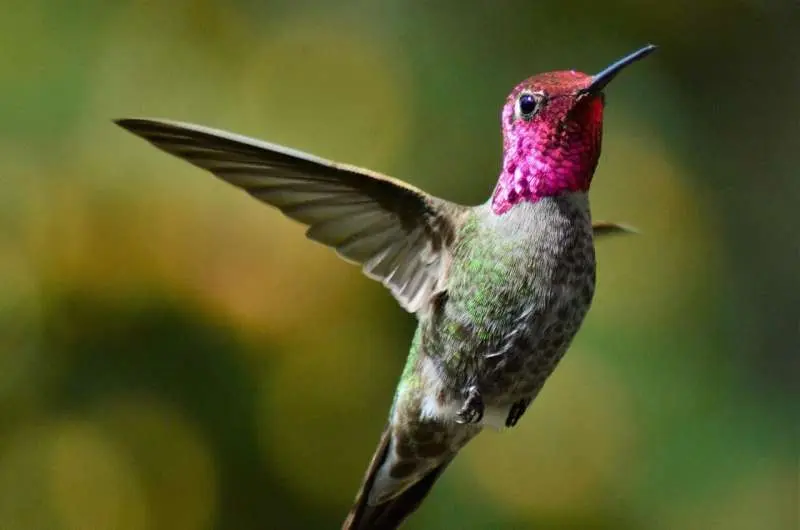
The brilliant magenta feathers on the head and throat of a male Anna's hummingbird present an optical puzzle. Magenta cannot be produced by a single wavelength of light. Instead, the feathers reflect a mixture of red and blue. Scientists understood the strong red reflection, but the weaker blue component was harder to explain.
Sangyeop Kim of Yonsei University and colleagues have now identified a previously overlooked region inside the feathers that helps supply the blue reflection. Their study in the Journal of the Royal Society Interface shows that this buried region works together with material near the surface to produce the distinctive color.
The team tested their explanation by gradually eroding the surface of the feather. As the blue reflection faded, the feathers' appearance changed from magenta to orange.
Finding the missing middle
Scientists already knew that these feathers owe their shimmering appearance to their internal architecture. A 2018 study measured the strong red and weaker blue reflections and modeled how stacked structures inside the feathers produced them. The calculations explained much of the color, but did not fully reproduce the blue component.
The new work examined those stacks more closely.
They sit inside barbules, the tiny branches extending from a feather's larger branches. Each stack contains flattened structures called melanosomes, which hold the pigment melanin. In Anna's hummingbird, these structures also contain air cavities and are embedded in feather protein.
Light waves reflected from the boundaries between these materials overlap, strengthening some colors and weakening others. The thickness and arrangement of the layers therefore help determine the color we see.
Earlier descriptions of the structures distinguished small melanosomes near the surface from larger ones underneath. But electron microscopy revealed a more gradual transition: beneath the smallest structures were two layers of intermediate thickness, followed by the thicker structures deeper inside. Much of the difference came from the size of their internal air pockets.
Computer models showed why that middle region mattered. Treating the underlying layers as uniformly thick produced a strong red reflection without a distinct blue peak. Including the intermediate layers brought the blue peak into view.
But those middle layers relied on the surface region above them to produce the blue color. "Neither layer alone was sufficient," the authors write. Adding the deeper layers mainly strengthened and sharpened the red reflection.
Etching away the blue
To test this cooperation in real feathers, the researchers used oxygen plasma etching, a treatment that gradually removes surface material.
After 60 seconds, the outer protein covering was almost entirely gone, and the barbules appeared reddish-orange. After 120 seconds, further erosion exposed air cavities in the upper melanosomes, and the color shifted toward yellowish-orange.
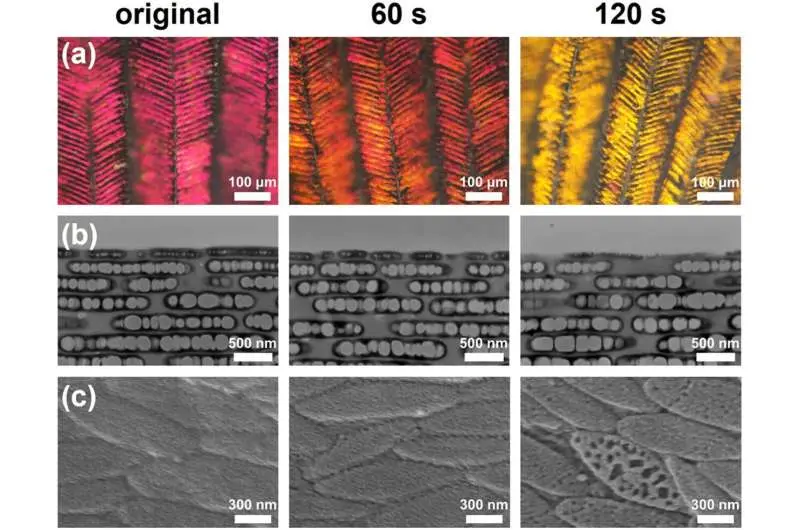
Measurements showed that the blue reflection weakened and eventually disappeared. Meanwhile, the dominant red reflection shifted toward shorter wavelengths, making it appear closer to orange. Together, these changes explained the visible transformation and supported the models' prediction that the surface and middle regions must work together.
How the different-sized structures develop as a feather grows remains unresolved. Researchers also do not yet know whether the same arrangement is seen in other hummingbird species.
The authors suggest that the design could inspire future materials with adjustable colors for displays or security markings. The key is in the structure of the feather itself: Tiny differences in buried air pockets help determine whether its reflected light produces orange or a conspicuous flash of magenta.
Written for you by our author Andrew Zinin, edited by Lisa Lock, and fact-checked and reviewed by Robert Egan—this article is the result of careful human work. We rely on readers like you to keep independent science journalism alive. If this reporting matters to you, please consider a donation (especially monthly). You'll get an ad-free account as a thank-you.
Publication details
Sangyeop Kim et al., Multi-periodic photonic mechanism for non-spectral magenta coloration in Anna's hummingbird (Calypte anna) feathers, Journal of the Royal Society Interface (2026). DOI: 10.1098/rsif.2026.0601
Who's behind this story?

Andrew Zinin
Master's in physics with research experience. Long-time science news enthusiast. Plays key role in Science X's editorial success. Full profile →

Lisa Lock
BA art history, MA material culture. Former museum editor, paramedic, and transplant coordinator. Editing for Science X since 2021. Full profile →

Robert Egan
Bachelor's in mathematical biology, Master's in creative writing. Well-traveled with unique perspectives on science and language. Full profile →
© 2026 Science X Network
Citation: A hummingbird's brilliant magenta feathers depend on a hidden middle layer (2026, November 9) retrieved 9 November 2026 from https://phys.org/news/2026-11-hummingbird-brilliant-magenta-feathers-hidden.html
This document is subject to copyright. Apart from any fair dealing for the purpose of private study or research, no part may be reproduced without the written permission. The content is provided for information purposes only.