



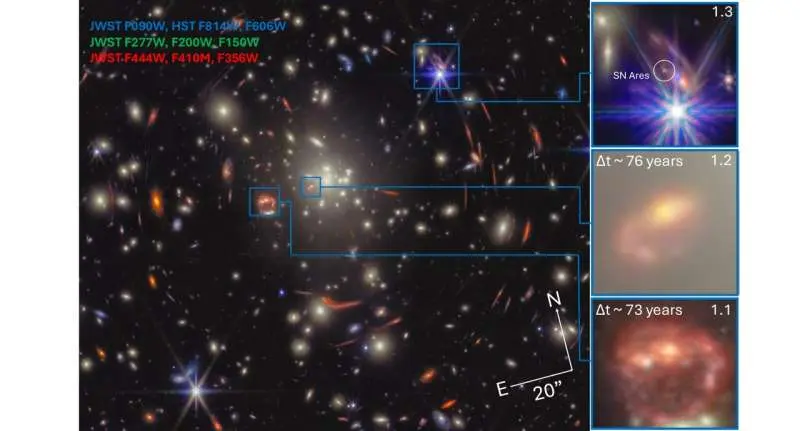
Thanks to the gravitational lensing caused by a massive galaxy cluster and high-resolution images from the James Webb Space Telescope (JWST), astronomers discovered an exploding star when the universe was 4.9 billion years old. The discovery paper, posted to the arXiv preprint server on Oct. 23, presents a prediction for when the rest of the distorted images of SN Ares will arrive.
Gravity bends light
When a massive galaxy cluster sits between us and a distant galaxy, the galaxy cluster's gravity acts like a natural lens, bending and magnifying the light coming from the background galaxy. This is called gravitational lensing, and it can result in the creation of multiple images of the same galaxy. When different light rays take slightly different paths, the images arrive at different times, sometimes hours apart and sometimes decades apart. Some of the famous examples of multiple-image lensing include Einstein Cross, Molten Ring and Smiley Face.
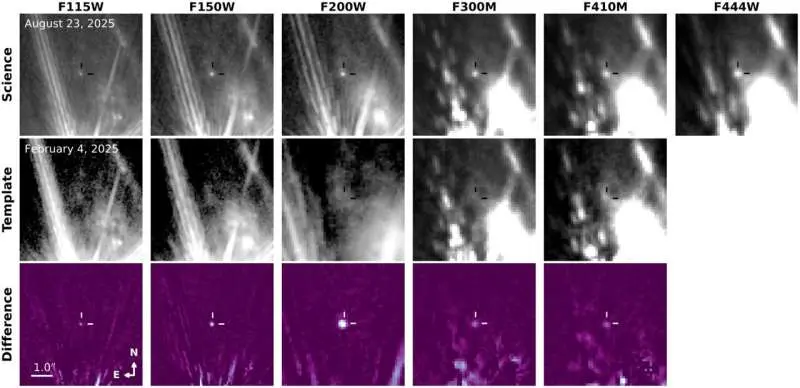
In this study, astronomers led by Conor Larison of the Space Telescope Science Institute report the discovery of a supernova that occurred around 8.8 billion years ago. They spotted SN Ares in August 2025 in the JWST's near-infrared images taken of the field of the galaxy cluster MACS J0308.9+2645.
JWST spectroscopy revealed helium and hydrogen features, which are telltale signs of a star losing most of its outer hydrogen layer before exploding—a category called the Type IIb supernova. Researchers say it is "the highest-redshift member of its class spectroscopically identified."
Two are yet to arrive
For now, astronomers are seeing only one magnified image of Ares. But their analysis using three lens models revealed that two more images of this supernova are yet to reach us. The predictions say that they will appear in about 73 and 76 years, respectively. At an assumed timeline of 70 years, "the SN Ares system has by far the highest predicted delays of any discovered lensed SN system so far," the team writes in its paper.
The delay in the arrival of these images depends on the geometry of space. But space is also expanding, with galaxies moving away from us and light getting stretched. So measuring the delay between when the images arrive also helps pin down the Hubble constant, the universe's expansion rate.
"Due to the direct relationship between these delays and geometric distance, a measurement of the offset in image arrival times leads to constraints on cosmological parameters such as the local expansion rate of the universe, H0," researchers explain.
If, in 70 years, astronomers can catch the return, the delay could be timed extremely precisely. That could give one of the most precise single measurements of the universe's expansion rate.
The team plans to conduct additional spectroscopic redshift measurements in early 2027. This will help researchers better understand the lens properties and improve delay predictions.
The study also offers a rare opportunity to watch gravitational lensing play out over generations. Researchers say that they cannot predict what the science of the universe will look like in 70 years, but are sure that the reappearance of SN Ares will be a scientifically rich event, worth looking forward to.
Written for you by our author Shreejaya Karantha, edited by Gaby Clark, and fact-checked and reviewed by Robert Egan—this article is the result of careful human work. We rely on readers like you to keep independent science journalism alive. If this reporting matters to you, please consider a donation (especially monthly). You'll get an ad-free account as a thank-you.
Publication details
Conor Larison et al., SN Ares: A Strongly Lensed Type IIb Supernova at z=1.276 with a Predicted 70-Year Time Delay, arXiv (2026). DOI: 10.48550/arxiv.2610.33161
Journal information: arXiv
Who's behind this story?

Shreejaya Karantha
Shreejaya Karantha is a science writer and astronomy communicator based in India, with a focus on astrophysics and the early universe. Full profile →

Gaby Clark
MA in English, copy editor since 2021 with experience in higher education and health content. Dedicated to trustworthy science news. Full profile →

Robert Egan
Bachelor's in mathematical biology, Master's in creative writing. Well-traveled with unique perspectives on science and language. Full profile →
© 2026 Science X Network
Citation: A cosmic magnifying glass could reveal the same supernova two more times in roughly 70 years (2026, November 14) retrieved 14 November 2026 from https://phys.org/news/2026-11-cosmic-magnifying-glass-reveal-supernova.html
This document is subject to copyright. Apart from any fair dealing for the purpose of private study or research, no part may be reproduced without the written permission. The content is provided for information purposes only.