



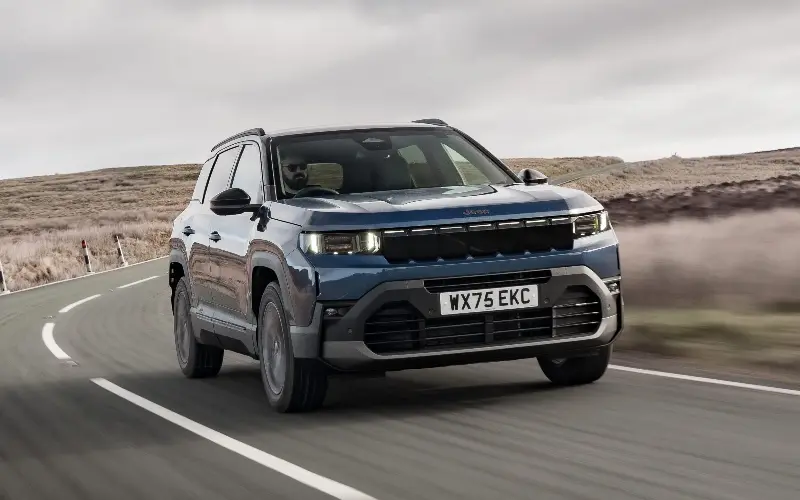
“Some pretend. Some don’t have to.” The advertising for the Compass is simple in concept. Other SUV owners, desperate for some off-road credibility, splash mud on their cars in secret. A Compass glides by, its owner a picture of confidence as he jinks off the tarmac to tackle a forest track. Next stop: the wilderness. Jeep’s off-road pedigree is not in doubt.
However beneath the skin there isn’t very much Jeep, as its platform is shared with fellow Stellantis models the Peugeot 3008, Citroën C5 Aircross and Vauxhall Grandland. Furthermore, four-wheel drive isn’t available yet. Does the Compass run the risk of being a Jeep in name only?
Pros
- Roomy interior
- Smart dashboard design
- Lots of kit for the money
Cons
- Unsettled ride
- Fiddly touchscreen
- No four-wheel-drive option yet
Choice of powertrains
There’s a choice of a 143bhp mild hybrid and a 213bhp electric motor. These will be joined by longer-range and dual-motor electric options, the latter of which will provide that all-important four-wheel-drive, as well as a 192bhp plug-in hybrid option.
For now, though, a 310-mile range is the most the electric Jeep can offer, allied to slightly underwhelming economy and charging figures; at 3.3mpkWh, the electric Compass looks less efficient than some of its electric rivals. And while the 160kW maximum charging rate looks impressive, average speeds across the curve are less so; it will take 36 minutes to charge from 10 to 80 per cent.
The e-Hybrid model has its own flaws to contend with. Average fuel economy of 49.6mpg is decent enough, but a 0-62mph time of just over 10 seconds means the Compass is slower than rivals such as the Volkswagen Tiguan and Kia Sportage.
It’s also not a great option if you need to tow; at 1,150kg, the hybrid Compass’s towing capacity is lower than that of the outgoing model.
So far, then, this is a Jeep that doesn’t do Jeep stuff all that well. But what about family stuff?
Family matters
For starters, it looks like excellent value. Prices start at less than £35,000 for the entry-level Altitude, which is pretty reasonable when you factor in the equipment on offer. Heated seats, a heated steering wheel, 18in alloy wheels, adaptive cruise control and front and rear parking sensors are standard even on the cheapest Compass.
The boot, which at 550 litres offers plenty of space – not quite as much as a Sportage, say, but still plenty. It’s a usefully square shape, too, so you can use the volume to good effect. Jeep also claims it has managed to squeeze in 34 litres of storage, for odds and ends around the front seats, in the form of cubbies, lockers, shelves, boxes, slots and so on. In short, it’s a useful space for family motoring.
It is pleasant in the front seats, too. There are lots of textures and materials, from the wipe-clean, rubberised switchgear to the anodised metal surround for the drive mode selector. There are some neat design touches, too, like the repeated X-shaped motif, intended to echo the pressing pattern on the jerry cans you’d usually find strapped to a Second World War vintage Willys.
All is not perfect, though. The unusually wide touchscreen looks good, but requires a stretch to reach its furthest extremity. The software powering it isn’t the best, either; a reskin of the standard Stellantis system, it suffers from the same tendency toward flashy animated graphics that slow it down and make it fiddlier and fussier to use than it needs to be.
On the face of it, the back seats are great, with acres of head and leg room. But all of the lovely materials surrounding those in the front have been replaced by nasty, scratchy plastics. Adult and child occupants alike may well feel short-changed – and I wouldn’t blame them.
On the road
They might also get a bit upset if you hurl the Compass too enthusiastically along a back road. It’s not that it rides firmly; more that the suspension doesn’t do enough to control the body, which therefore wafts and wallows over crests and into compressions.
Neither is the suspension all that good at damping out the smaller ruts and bumps of urban and country roads. The resulting slightly nauseating jitteriness makes progress rather less relaxing than you’d like.
These tendencies are more pronounced in the electric version, which comes as no great surprise since its extra weight gives the suspension more work to do. The hybrid version is better, but it still isn’t exactly relaxing – especially since you often have to really rev the 1.2-litre, three-cylinder engine to get it moving.
Granted, the body doesn’t lean over too much – which comes as a surprise given that the suspension feels so floppy – and there’s plenty of grip, so you get the impression the Compass has the makings of a car you could flow down a back road surprisingly well.
But there’s an artificial snappiness to the steering around the dead-ahead that means you often end up turning in more sharply than intended. You can drive around it, of course – but you shouldn’t have to.
The Telegraph verdict
Here we have a Jeep that’s not very good at towing and, for the time being at least, not much cop off-road, either.
The Compass is not without merit, though. It is great value, well equipped, roomy and practical. It’s a shame the ride quality, powertrains and interior materials aren’t better resolved, but it’s still likely to appeal to family buyers who care less about such matters than they do about chunky styling and low monthly payments.
More than ever, though, the Compass feels like a Jeep that spends all its time trying to make you believe it’s something it isn’t.
The facts
On test: Jeep Compass 1.2 e-Hybrid 145 First Edition
Body style: five-door SUV
On sale: now
How much? £35,835 on the road (range from £34,635)
How fast? 121mph, 0-62mph in 10.3sec
How economical? 49.6mpg (WLTP Combined)
Engine & gearbox: 1,199cc three-cylinder petrol engine, six-speed automatic gearbox, front-wheel drive
Electric powertrain: AC permanent magnet synchronous motor with 0.9kWh battery
Electric range: 0 miles
Maximum power/torque: 143bhp/170lb ft
CO2 emissions: 129g/km (WLTP Combined)
VED: £455 first year, then £200
Warranty: three years / 60,000 miles (no mileage cap in first two years)
Spare wheel as standard: no (not available)
The rivals
Volkswagen Tiguan 1.5 eTSI Life
128bhp, 47.7mpg, £38,920 on the road
This entry-level Tiguan is £3,000 pricier than the Jeep, has less equipment and will feel even slower. But its quality interior, comfortable ride and huge boot will win fans.
Kia Sportage 1.6 T-GDi GT Line
147bhp, 39.8mpg, £33,895 on the road
Britain’s best-selling family SUV for good reason. A pleasure to drive, practical, comfortable and reliable, although relatively thirsty.