



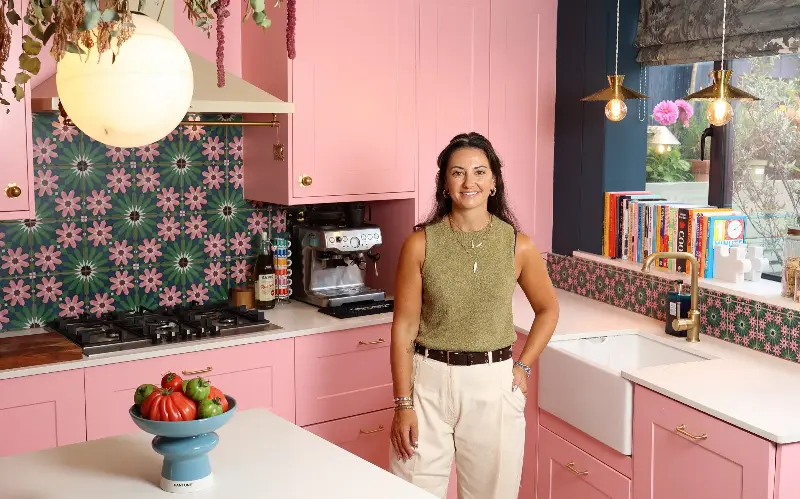
When Lia Gold was younger, she didn’t dream of being an interior designer. “I didn’t even know that was a career,” recalls the 34-year-old. “I wanted to be a vet, which is hilarious because I failed pretty much every exam at school.”
Now, after winning BBC One’s Interior Design Masters in April, she has found her true calling. She launched her first homeware collection with Next in June, started a new supper club business, a podcast – ‘Til Design Do Us Part – with fellow contestant Jonni Knight, and perhaps most importantly, her own design studio, which has already won its first crop of clients.
Learning to love a featureless new-build
Amid all that, Gold’s east London home, which she and her husband bought in 2022, has been her bright, colourful sanctuary where she has not only practised but finessed her design sensibility.
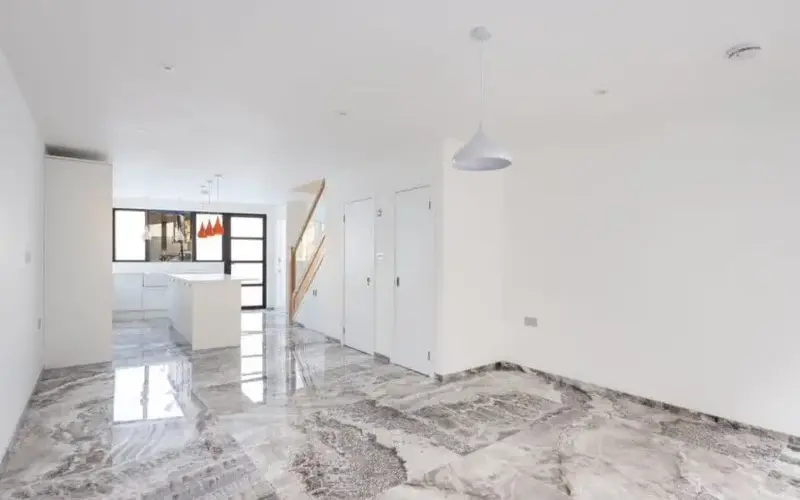
On first viewing it, Gold admits that the two-bed, three-bathroom home, built on the site of a former car garage, wasn’t exactly what she was looking for.
“Initially I hated it,” she laughs. “I don’t like new-builds. I don’t think they have any character. But in London you often need a million pounds to buy a characterful old property, which I didn’t have.”
On closer inspection, the property offered an expansive open-plan downstairs area and a beautiful kitchen. “Aside from it being clinically white, the space itself was welcoming, I could visualise having dinner parties around the island,” she explains.
Because the downstairs space was so open plan, Gold couldn’t make structural changes, so her focus was on using colour and pattern to “section off” the kitchen and living areas.
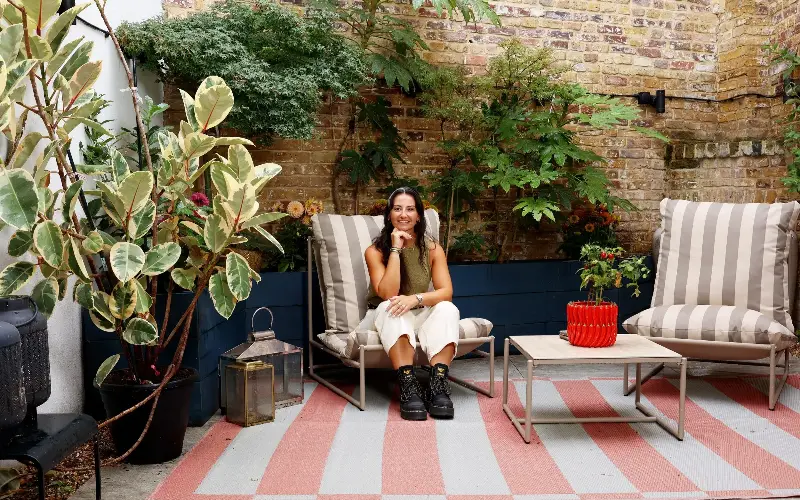
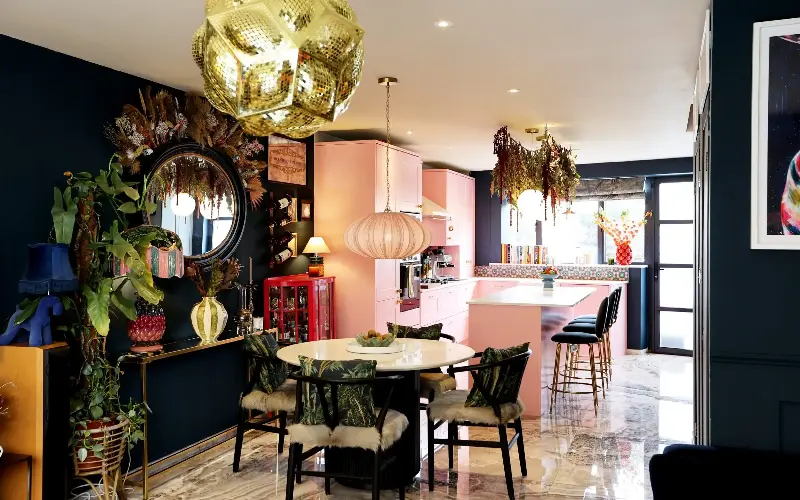
“We’ve got the bright pink kitchen which is covered in patterned tiles, then you go back into the living areas which are dark blue and a bit more calming and cosy, before it opens back out into the light and brightness of the courtyard,” Gold says.
The living area at the back features a contrast between dark blue paint and a tropical-feeling jungle wallpaper. “I think wallpaper is a great way of adding texture but it’s a space of two halves,” she adds. “The wall behind the TV is very plain in comparison to the wall behind the sofa, because I think a patterned wallpaper like ours can be quite visually stimulating. When you just want to wind down in front of the TV, you don’t want that.”
A Barbie-pink kitchen
When Gold moved in, the kitchen remained a sticking point. “My friends were surprised at how long it stayed white,” she says. “But I wanted to understand how I used the kitchen before I did anything.”
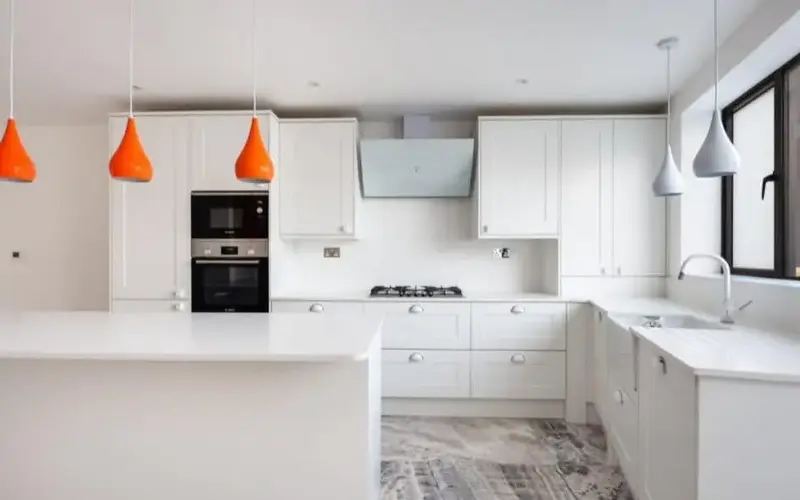
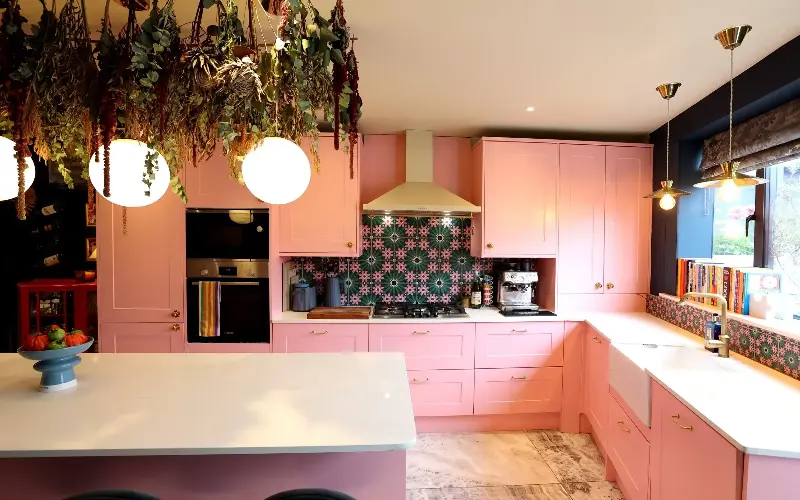
The “Barbie-pink” colour was inspired by Gold’s time on the show. “I’d done a kitchen on the show that was bright red,” she explains. “I loved seeing how much people enjoyed the colour of it and the way it had a huge impact on making them want to be there. Our downstairs is quite dark – our kitchen windows are frosted – so I decided on bright pink.”
The other eye-catching element of the kitchen’s design is Gold’s use of patterned tiles. “You can have so much fun with tiles,” she says. “My design style is very botanically-inspired so it felt right. My tiles remind me not only of travelling in Spain and Seville, but also of Bali and the Philippines where my husband and I spent time.”
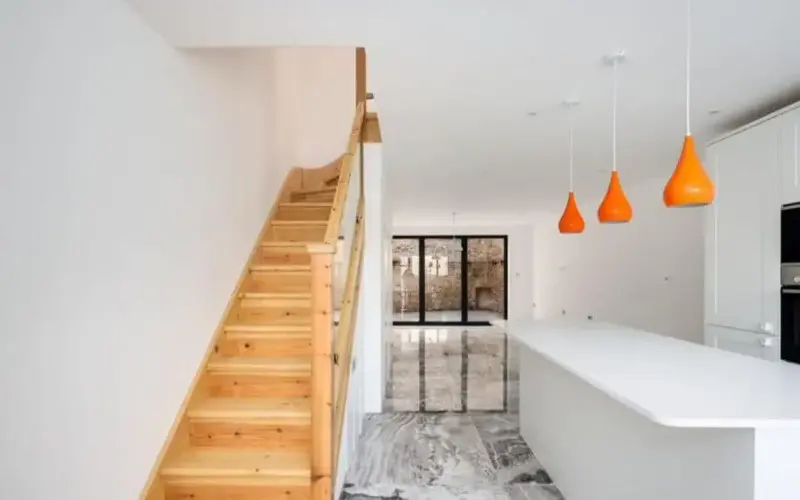
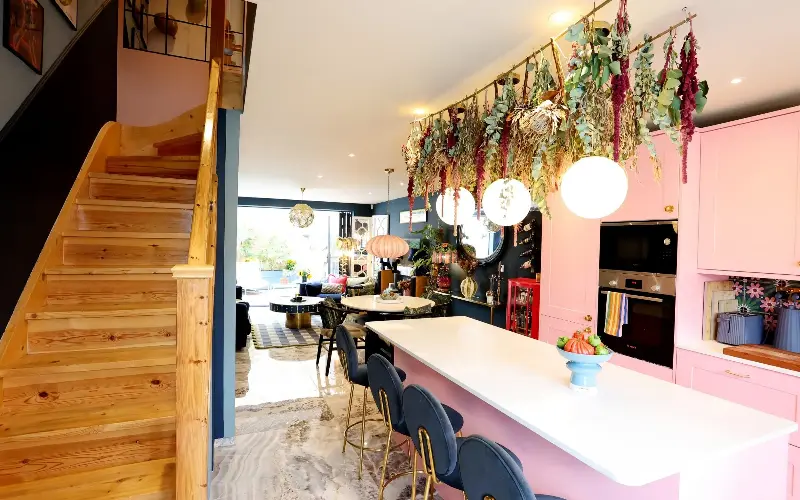
Then there is the huge display of dried flowers, reused from her wedding, which hang above the kitchen island. “We spent a lot of money on wedding flowers and I couldn’t bear to see all that go in the bin afterwards, so we drove them back and made them into the ceiling fixture,” she says. “Using unusual materials adds a huge amount of personality to your home.”
Creating a bedroom which is both enlivening and calming
The master bedroom was the first room Gold redecorated, although she admits it took some time to get it right. “I like to wake up feeling motivated, but I want to go to bed feeling sleepy,” she explains. “That’s the challenge of bedrooms, they have to serve two different functions at different times of the day, and it’s hard to strike a balance.”
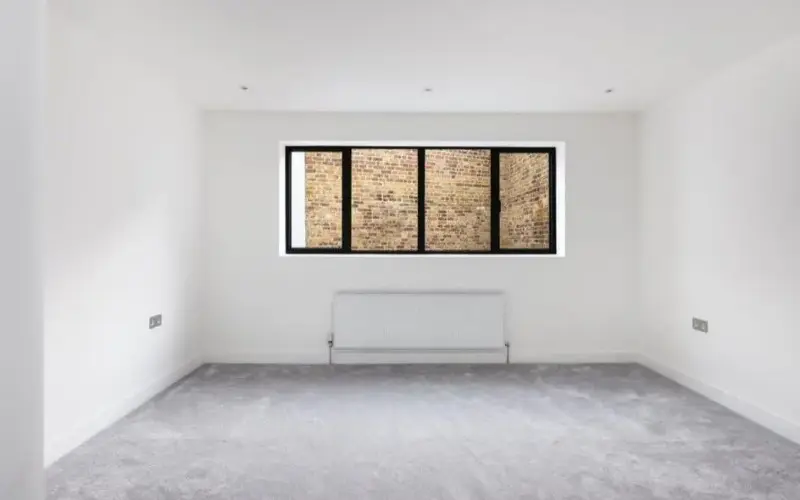
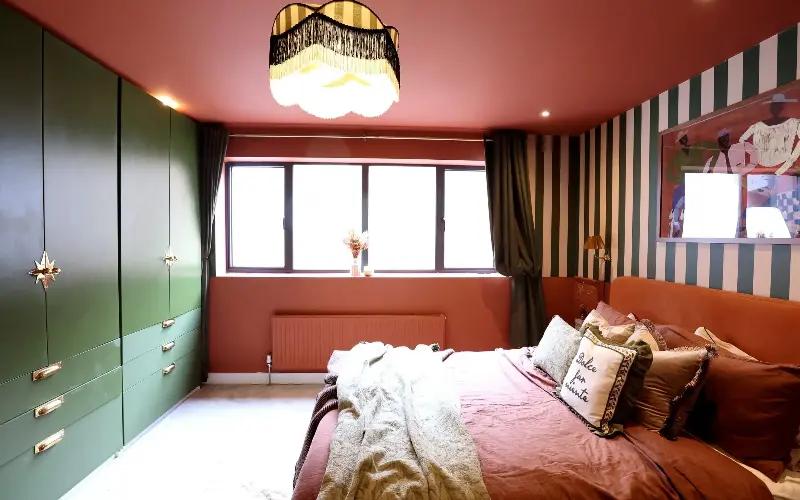
In the end she was inspired by the outside view. “The space is dominated by a big window through which you can see warm browns and oranges from the bricks outside,” she continues. “So I brought that inside. The bottom half of the room is terracotta which is calming, while the top half brings back my love of patterns with avocado and tahini stripes.”
The green wardrobes were a repaint of a simple IKEA product, the colour chosen to blend into the walls to make them look more fitted. “I found some old-fashioned gold handles to make them feel a bit more elevated too,” adds Gold.
Finally, the lighting. “I have these gorgeous brass uplighters and downlighters which shine both ways. That disperses light, which makes it feel calming and less stark.”
Finding the right furniture
Like many millennials, Gold’s path through the housing market has involved plenty of different properties, from her family home in Scotland and rented flats through to her current house.
Along the way she’s picked up plenty of different furniture, much of it found secondhand on Facebook Marketplace. “The other place I get my furniture is the British Heart Foundation’s eBay shop, and Emmaus second-hand stores,” she advises.
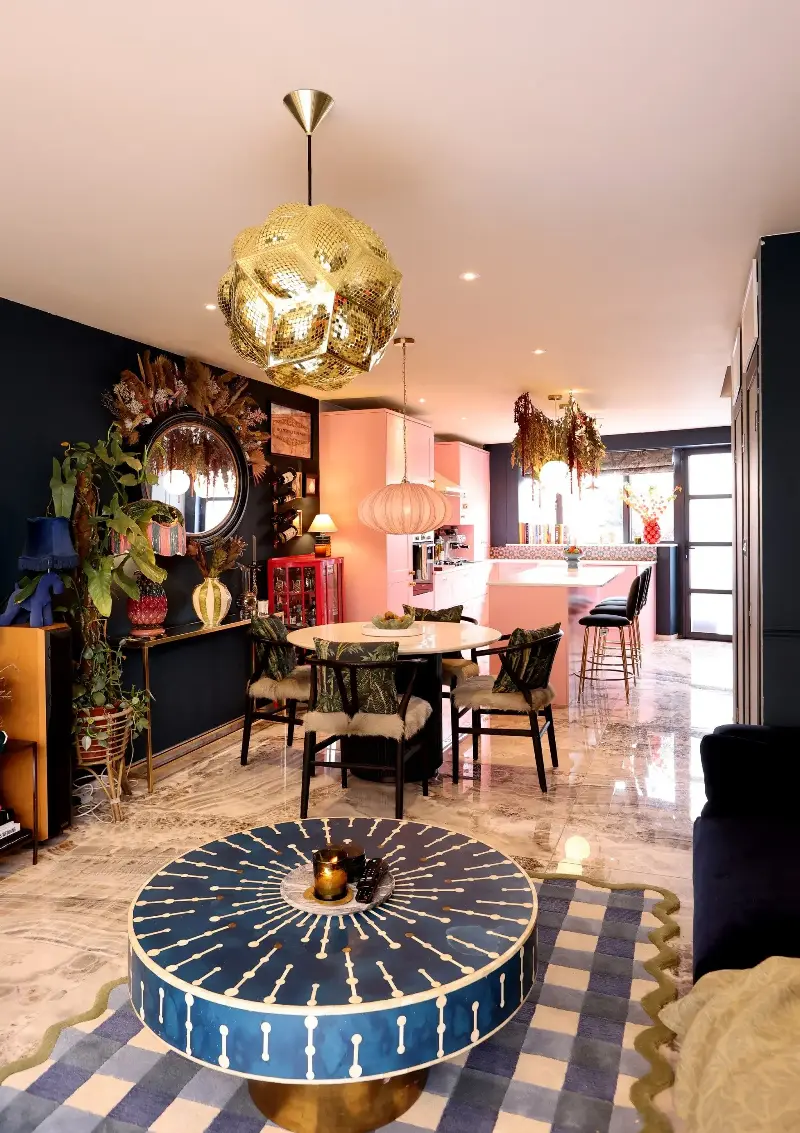
The jewel of her collection is the marble dining table from Cult Furniture. “I knew I loved it from the moment I saw it, but obviously a marble table is very pricey,” she says. “I waited and set up an alert on Marketplace for anything ‘marble’ and ‘Cult Furniture’. I eventually found the exact one I wanted in south London and picked it up in an Uber.”
The circular table fits perfectly between the kitchen and living room. “Sharp edges can feel quite harsh, but with that nice round table you could fit four people, and then I added a big mirror with even more botanicals to help give the dining area its own space,” she adds. “It just goes to show that you can plan a space then save up and buy the items later instead of rushing.”
Lia Gold’s three tips for decorating a new-build
Embrace colour
Gold laments that people often think they can’t use too much colour in a space for fear of making it look smaller. “The opposite is true,” she asserts. “You can always use colour. You just have to address ‘what do you want the space to do?’ If you want it to feel cosy and cocooning, then you use darker colours. If you want it to be airy and bright, use lighter ones.”
Testing out colours is vital. “In our hallway there’s lots of different light – some areas have natural light, others have none, some have lots of artificial light,” Gold explains. “I put up paint samples in every single spot where the light hits differently. People don’t realise that colour looks different under different bulbs, so you should sample a lot.”
Play with texture
“Mixing textures is how you create spaces that feel elegant and curated,” Gold says. “Especially with wood tones – if you go into a room where all the wooden furniture is the same, you feel like you’ve walked into an oak furniture warehouse. Whenever I start designing a room, I get samples of all the different textures and make a physical tray, where I put down the fabric samples for the chairs, the woods, the glass and see how they look together.”
Sometimes people worry about a home looking cluttered if they do “too much”, thinks Gold, “but I think the trend for minimalism is behind us,” she says. “People don’t want to see catalogue homes, they want homes with personality. You have to think about how you display the things you care about – put things in pairs or trios on shelves so they balance.”
Decide the “non-negotiables”
Other than interior design, Gold’s passion is hosting, and that fed into her approach to designing the kitchen. “I wanted to be able to put down a hot pan on a surface, find a place to have my cookbooks out, and be able to wipe down the island straight into the bin,” she says. “If I was designing a kitchen for someone who hates cooking, that would be a very different design process.
“The trick is to decide what your must-haves are. In my bedroom, for example, I hate having to hide away all my hair brushes and moisturisers – I use them every day, so it’s just going to make my life more difficult to do that. So then ask how you can display those things nicely.”