



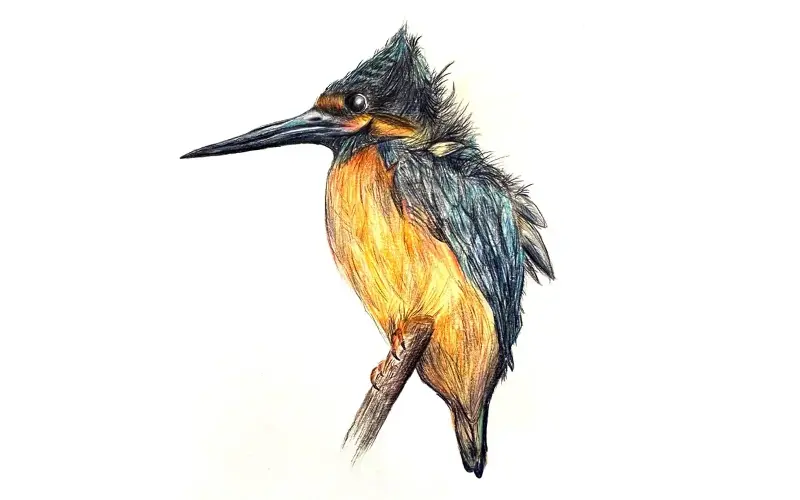
There’s a sweet story behind Prince George’s drawing of a kingfisher, which features in a new issue of Country Life magazine guest-edited by his father, the Prince of Wales. Prince William produced his son’s study while exchanging ideas about what should appear in the special edition he was overseeing, but told the magazine’s editor, Mark Hedges, it should only be reproduced if he considered it “good enough”.
How delightfully modest. Prince William has every right to be proud of his son’s talent – and I say this as his former primary-school classmate who loved drawing so much that he told me I could one day be his “court artist” (Your Royal Highness, I haven’t forgotten). Because as soon as I saw George’s picture, even in reproduction, I thought it was excellent.
George, who executed it this spring when he was 12 years old (and whose grandfather is, of course, an enthusiastic watercolourist), is hardly the first budding artist to find beauty and interest in the natural world. While, I assume, his source was a close-up snap by a wildlife photographer, which he painstakingly copied, the composition is a feat of close looking that will surely impress his new art master at Eton (where he’s in his first term).

Skilfully, he analyses the various textures of the bird’s vibrant plumage, and relishes the pleasing chromatic contrast between its darker feathers and the fiery orange-yellow upon its breast. There’s even a hint of iridescence to some of the seemingly blue wing feathers, which complements the sheen on the creature’s beak and the glint in its eye. Pleasing visual echoes link the line of the kingfisher’s bill, that of its tail, and the shape of the branch upon which it sits.
I like the fact, too, that this kingfisher’s plumage is slightly ruffled – which animates the image and, perhaps, suggests a touch of (autobiographical?) adolescent mischief. If this bird were a new pupil at Eton, he’d be told to brush his hair.

Was George thinking about the symbolic significance of the kingfisher? I doubt it. But if I were his art teacher, I’d suggest he should. Although the common kingfisher doesn’t appear in Colin Rees’s excellent recent art-historical study The Secret Language of Birds, it has played a role in the history of art and heraldry, and is associated with peace. A surreally oversized kingfisher appears in the central panel of Hieronymus Bosch’s triptych The Garden of Earthly Delights; the kingfisher was the emblem of the medieval King Wenceslaus IV of Bohemia. In China, too, kingfishers were prized by the elite, who sported elaborate ornaments, jewellery and headpieces incorporating their radiant feathers. Examples of the latter appeared in the British Museum’s China’s Hidden Century exhibition in 2023.
White ostrich feathers are the most recognisable component of the heraldic badge of the Prince of Wales, which George will eventually receive. For now, though, the public will associate him with the brilliant blue of a kingfisher darting over a stream.