



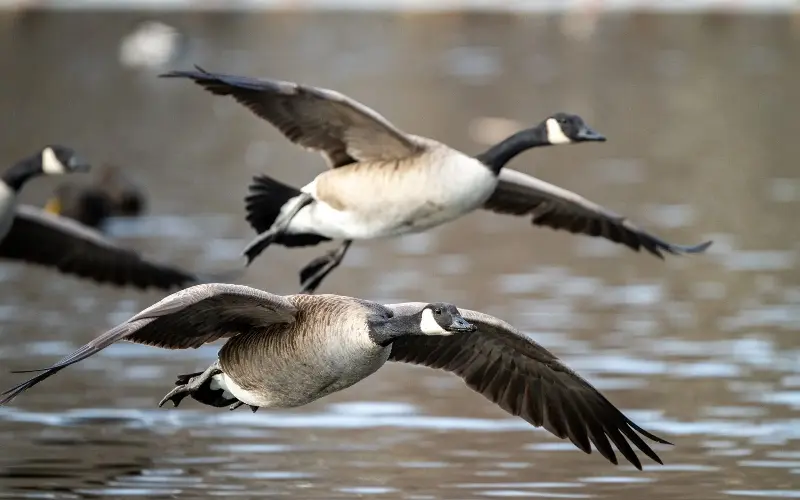
The standard advice for cooking Canada Goose, is to first baste with butter. Season with salt and pepper, and stuff the cavity with a lemon and a house-brick. After slow roasting for five hours, remove the bird from the oven, throw the lemon and the goose in the bin and eat the brick.
It is, perhaps, unfair to criticise the Canada Goose for its lack of culinary qualities. The reason this North American wildfowl was introduced to Britain – St James’s Park in 1678 for the record – was as an ornamental, not a table bird. The Honker swiftly became a fashion statement among the landed gentry. No ornamental lake or water feature was deemed complete without a pair of Canada Geese swimming in stately procession about the margins.
As is the case with so many of the species introduced to Britain for their aesthetics and novelty, the Canada Goose thrived in our mild climate. Their numbers are now problematic. They, along with Muntjac and Chinese Water Deer, the Grey Squirrel and Ruddy Duck have shifted from quirky exotica to full-blown pest.
The culling of Canada Geese, by a licensed pest controller, at St George’s Hill Tennis Club in leafy Surrey, is said to have caused “fury”. Club members, local residents and, inevitably, animal rights groups have all taken to social media to bemoan the action. It would be fair to say that the optics of culling geese and goslings at this time of year are perhaps uncomfortable. Yet pest control at any time of year is a contentious topic for those not directly involved with conservation.
The Canada Goose has few friends within the conservation, aviation and farming sectors. All note that the 250,000 or so strong population is problematic. The Wildlife Trusts admits the Canada is an “Introduced, non‑native species” while the RSPCA highlights the Canada’s propensity to “damage habitats”. They are notorious for denuding the nesting sites of migratory species such as Pink Foot, Whitefront and Bean Geese, all of whom actually belong here.
As the tennis club’s members noted, the ambling geese are prone to “leave their poo” on the courts. That poo may be an inconvenience on the baseline, but it is recognised as one of the leading vectors for avian influenza. The UK’s Animal & Plant Health Agency (APHA) confirmed multiple cases of H5N1 in Canada Geese during the most recent outbreaks.
The skies above Weybridge are on Heathrow Airport’s flightpath. Civil Aviation Authority (CAA) data reveals that Canada Geese appear in the Top 20 most frequent bird-strike species in their 2023-2024 dataset. An aircraft strike by a Canada Goose is significant, male birds weigh in at around 6.5kg, and they are the largest goose in Britain.
One also presumes, being a traditional tennis club, that St George’s serves Robinson’s Lemon Barley Water as a matter of course? As the Government’s nature quango, Natural England, points out: “Canada Geese cause significant agricultural damage through grazing and trampling.” Large flocks of Canadas can and do strip newly sown wheat or barley very quickly.
St George’s said their decision to reduce the local Canada Goose population was one “not taken lightly”. Quite right too. Culling any species, be it native or non-native, should never be done on a whim. Clearly in this case the pest-controller was both qualified and efficient. It is a question worth asking. If the pest controller had been killing brown rats, another non-native species, rather than Canada Geese, would the club members and animal rights fraternity still be so furious? Deciding on whether or not to cull an invasive species based solely on their looks is surely an idea for the birds?