



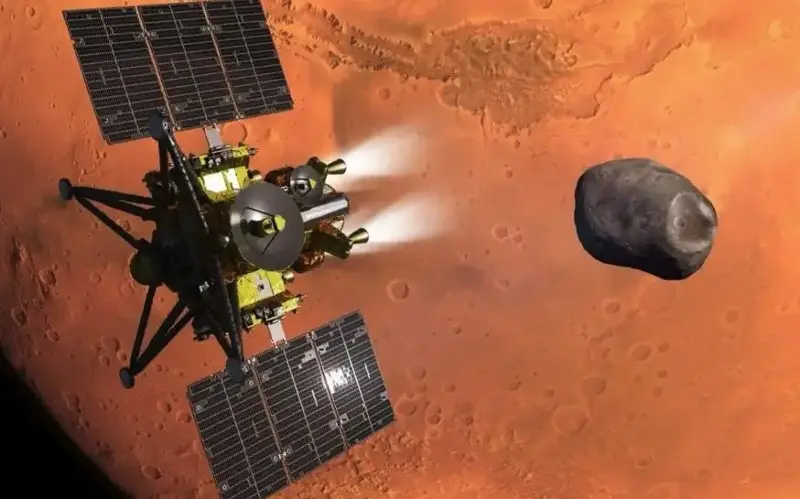
Martian moon rock is set to be brought to Earth for the first time under a Japanese-led space mission.
The Mars Moons Exploration (MMX) mission, planned for launch on Monday night, will be the first spacecraft to orbit Phobos and collect samples from a moon’s surface other than our own.
Phobos is the larger and innermost of the two natural moons of Mars.
It will also mark the first time any samples have been brought back from the Mars system.
The Japan Aerospace Exploration Agency (Jaxa) mission will use special technology to help land, manoeuvre and collect samples robotically in the extremely low gravity on Phobos.
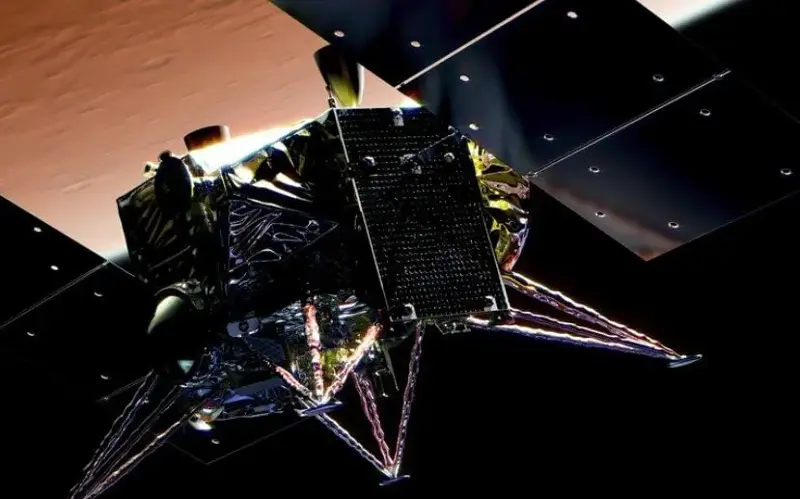
There is even hope that the moon dust collected could contain traces of ancient life on the Red Planet.
Dr Megan Argo, reader in astrophysics at the University of Lancashire, said: “Although there is no guarantee that Mars ever supported life, we know that the planet was warmer and wetter in the past, potentially creating conditions suitable for it.
“If life did exist on Mars, impacts could have ejected traces of it or its byproducts into space, with some material potentially ending up on Phobos.
“Finding such evidence is a remote possibility, but it adds to the scientific interest of the mission.”
The spacecraft will blast off from the Tanegashima Space Centre in Japan and arrive in the Mars system in August 2027, before entering Phobos’s orbit a month later.
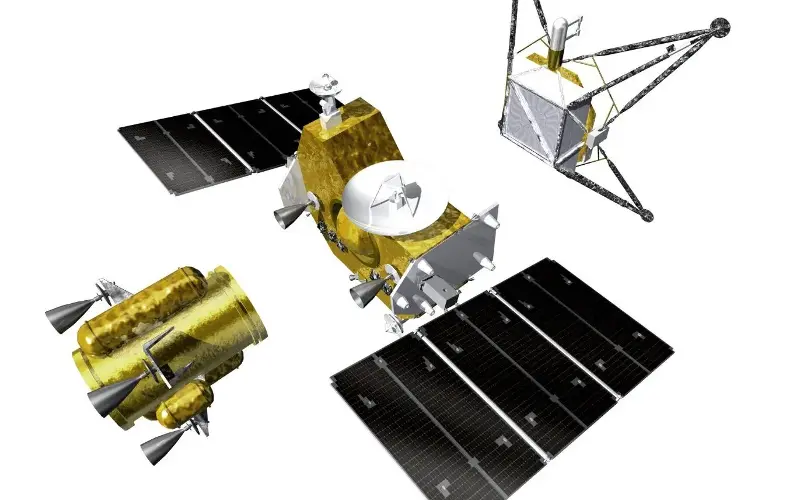
The main MMX spacecraft will study Phobos from a distance, before deploying a rover called Idefix to the moon’s surface, and finally landing on Phobos in 2030 to collect samples in a capsule to return to Earth.
This module will return to Earth in 2031 with at least 10g of moon dust, landing in Australia before being transferred to Japan. Its findings will be shared with mission partners including Nasa, the European Space Agency (Esa) and the French and German space agencies.
“Bringing samples to our most sophisticated labs here on Earth is a multiplier for discoveries, because our most precise instruments are too large, complex or sensitive to send to space,” said Elliot Sefton-Nash, Esa MMX Project scientist.
“Even after the mission has been completed, future generations of scientists will study the Phobos samples with even more advanced instruments – samples brought to Earth are the gift that keeps on giving.”
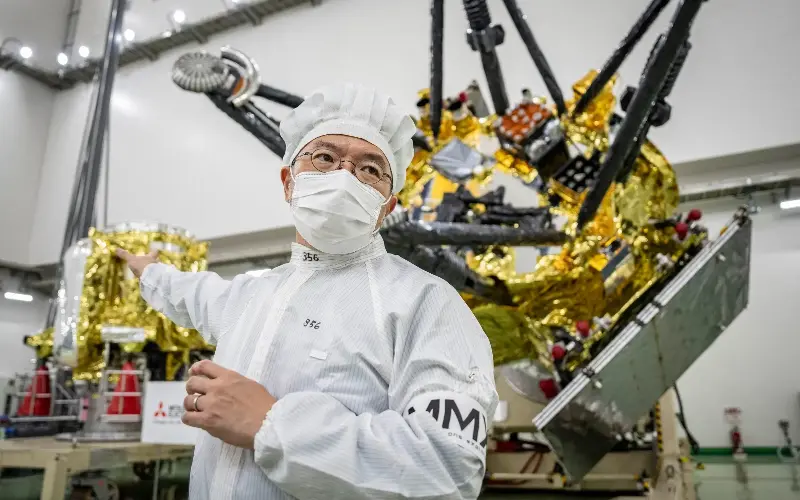
Mars has two moons: Phobos, meaning “fear”, and Deimos, “terror”, but they have remained largely unexplored, leaving questions about how they formed.
It is unknown whether they are asteroids that were captured into Mars’s orbit, or remnants of debris thrown into orbit after a giant collision on the surface of Mars, similar to how Earth’s moon was formed.
The mission will give scientists access to pristine material from Phobos, allowing them to study the chemistry and mineralogy, helping establish which scenario is more probable.
Although Martian meteorites have reached Earth, they are often contaminated by their journey through space, and damaged during entry into the atmosphere.
“The data and samples returned by MMX are a window to study the evolution of Mars and the Solar System,” added Mr Sefton-Nash.
MMX will also be the first mission that returns to Earth after visiting the Mars system.
The mission carries 11 science instruments: seven on the main spacecraft, and four on the rover. The main spacecraft also carries a radiation monitor, two high-resolution cameras and two different sampling devices.
The rover weighs 25kg but the gravity on Phobos is so low that Idefix will only weigh the equivalent of 15g on its surface.