



Spain has close to 3,500 beaches, ranging from blustery Atlantic bays to gracious, palm-fringed urban strands and wave-brushed emerald coves. Sunseekers, adrenalin junkies, climbers or seafood-lovers – no one is left unrewarded.
This bewildering variety means any selection of seaside spots can only ever be a random snapshot, and the dual forces of mass tourism and social media mean that you’ll struggle to uncover anything truly “secret”. With a little effort to get off the beaten track, however, what you will find is something that combines natural beauty with local community; a place to experience the traditions and hospitality of Spain proper.
Tazones, Asturias
You reach this charming Asturian fishing village via a serpentine drive down a narrow, winding road, to where brightly painted houses are stacked above a small but active port, dotted with lobster pots. The beach here is small, but the real draw for tourists is the coastal path just east of town, leading to fossilised dinosaur footprints embedded in the shoreline – visible at low tide.
In late August, don’t miss the reenactment of Charles V’s unexpected landing in 1517. The entire village decks out in period costume for medieval fairs and feasting.
How to do it: Fly to Asturias Airport with Iberia, then drive an hour to Tazones. Hotel Rural Alavera has rooms from £71.
La Isleta del Moro, Cabo de Gata, Almería
La Isleta del Moro is smaller and more self-contained than neighbouring villages in the Cabo de Gata national park, with a handful of white houses gathered around a shallow bay where colourful fishing boats bask on the sand. The surrounding landscape is stark – volcanic rock and low scrub – and largely protected from development. From the edge of the village, a footpath leads towards Cala del Peñón Blanco, a broad, empty stretch of sand reached after a 10-minute walk along the coast.
How to do it: EasyJet has flights to Almería Airport. From there it’s a short drive to La Isleta del Moro. Rooms at Hotel Los Patios – Parque Natural start at £86.
El Rompido, Huelva
El Rompido sits on one side of the Río Piedras estuary, surrounded by protected marshlands loved by birdwatchers. The town faces La Flecha – a long and unspoilt sandbar that you reach via a quick, regular passenger ferry. The beach along the spit stretches for miles, backed by dunes and pine forest with no buildings in sight. Back in El Rompido itself, the stretch of sand is lively with chiringuitos (beach bars), while the natural protection of La Flecha makes the town beach a great base for mastering various watersports.
How to do it: You can fly to either Portugal’s Faro Airport, an hour’s drive from El Rompido, or Seville Airport, followed by an hour-and-a-half drive. Islantilla Beach Golf Resort has rooms from £67.
Garachico, Tenerife, Canary Islands
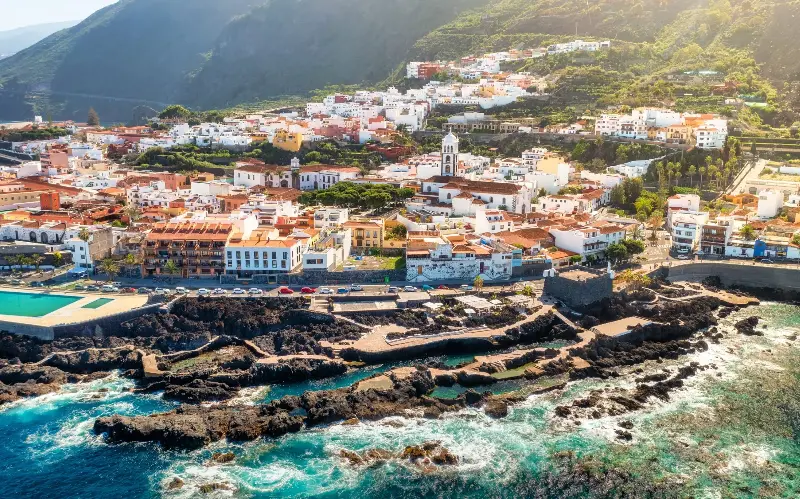
Garachico’s coastline was dramatically reshaped by a 1706 volcanic eruption, which partially destroyed the old town. That which remains comprises a pretty, low-rise jumble of cobbled streets and colonial architecture, fanning out from the town square and backed by banana plantations.
The lava flow was responsible for one of Garachico’s most curious features – the El Caletón series of natural lava pools, with steps and sheltered basins that fill with clear Atlantic water, forming a rocky aquatic playground. If it’s sunbathing you’re after, however, you’ll need to head to nearby Playa la Caleta.
How to do it: Fly to Tenerife via Tenerife North or Tenerife South, then drive less than two hours to Garachico. Rooms at Hotel El Patio start at £95.
Sant Carles de la Ràpita, Catalonia
At the Ebro Delta’s southern edge, Sant Carles de la Ràpita provides access to the Trabucador sandbar, a narrow strip thrusting into the sea with shallow water on both sides – reachable by car or bike. Flamingos frequently grace nearby lagoons, and the delta provides plenty of hides and tours for birdwatching of a less flamboyant nature. Hire a bike to glide gently through the rice paddies and make sure to allow for plenty of food stops – some of the shellfish native only to this area should not be missed.
How to do it: Iberia has flights to Barcelona-El Prat Airport. From there it’s a two-hour drive to Sant Carles de la Ràpita. Hotel Carlos III has rooms from £63.
Fornells, Menorca, Balearic Islands
Set around a wide, sheltered bay on Menorca’s north coast, Fornells is a still quaint fishing village with just enough going on to feel animated without tipping into resort territory. The harbour is lined with low-slung, whitewashed houses and a steady trickle of fishing boats, and its beaches are a 10-minute drive away (Cala Tirant offers a long sweep of sand with shallow water) – though the port itself has artificial bathing platforms for sunbathers and swimmers. Try the caldereta de langosta, the island’s signature lobster stew, at Es Cranc.
How to do it: Fly to Menorca Airport with Lufthansa, then drive or take a taxi to Fornells. Rooms at Hostal La Palma start at £85.
Cudillero, Asturias
Cudillero’s picturesque port, set against an amphitheatre of coloured houses, draws the cameras, but the real reward lies in climbing its steep network of narrow paths and staircases to viewpoints such as the Mirador de la Garita and the Mirador del Pico. Don’t miss the less-obvious pedestrian river tunnel carved through the rock, connecting village sections and emerging unexpectedly above the port for a delightful surprise. For beach time, I’d recommend driving 15 minutes to Playa del Silencio, a shell-shaped cove of grey pebbles and otherworldly rock formations.
How to do it: Asturias Airport, with flights from the UK on British Airways, is just a 15-minute drive from Cudillero. Hotel Casona de la Paca has rooms from £97.
Tamariu, Costa Brava, Catalonia
Tamariu, named for the tamarisk trees lining the seafront, marks the start of the Costa Brava proper and hovers in character between the bucket-and-spade resorts to the south and the elegant coves dotted with architecturally designed holiday homes to the north. The village curves around a sandy bay bringing shallow and crystalline water.
The walks along the coastal Camí de Ronda from here are spectacular – head south for the quiet, pebbly Cala Pedrosa, or continue over the headland through pine forests to the Sant Sebastià lighthouse and beyond to the lively resort town of Llafranc.
How to do it: You can fly to either Girona or Barcelona, followed by a one-hour or one-and-a-half-hour drive respectively. Rooms at Hotel Tamariu start at £93.
Los Caños de Meca, Cádiz, Andalusia
A former hippie hangout, Los Caños de Meca retains a relaxed and bohemian air. A loose cluster of low houses and sandy tracks, it has no real centre, just a scattering of small shops, surf schools and beach bars. Wander up to Torre de Meca and onwards along the cliff path towards the Faro (Lighthouse) de Trafalgar, with uninterrupted views over the Atlantic and, on clear days, the coast of Africa.
How to do it: Vueling Airlines has flights to Jerez de la Frontera. Then drive one hour to Los Caños de Meca, where Hostal Mar de Frente has rooms from £72.
O Grove, Pontevedra, Galicia
On a small peninsula at the entrance to the Ría de Arousa, O Grove is a no-nonsense fishing town known for its shellfish. A short bike ride or drive leads to Praia da Lanzada, an apparently endless beach backed by dunes. I like to visit for walking and, on calmer days, swimming. Back in the centre, O Peirao looks unremarkable from the street but is one of Galicia’s most authentic seafood experiences – and good value to boot.
How to do it: Fly to Santiago-Rosalía de Castro Airport with KLM, then drive one hour to reach O Grove. Rooms at Hotel Boutique Cata & Rose start at £174.