



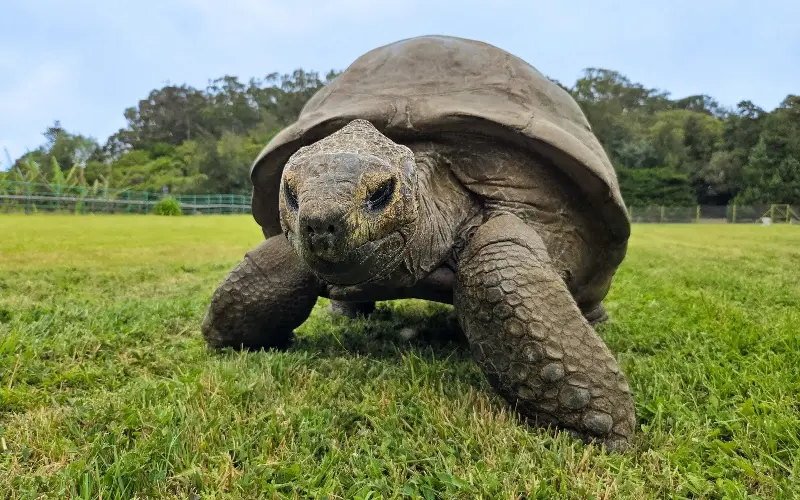
Jonathan, the 194-year-old giant tortoise, has the supergenes of a five-year-old to stop his cell batteries from running down, scientists have found.
In a discovery that could have implications for slowing human ageing, researchers found that the Aldabra tortoise was carrying 287 unique gene variants that were driving his longevity.
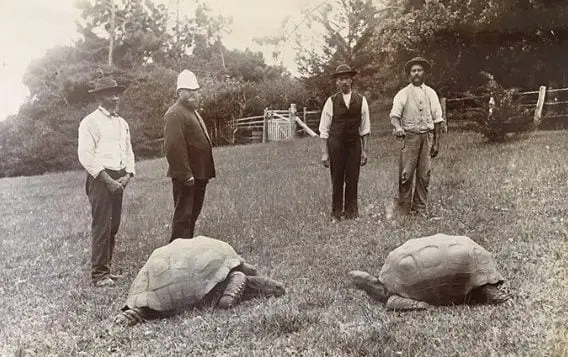
Jonathan is the world’s oldest land animal, estimated to have hatched in 1832 when King William IV was on the throne, five years before the accession of Queen Victoria.
He has lived most of his life on St Helena, the British Overseas Territory in the South Atlantic Ocean, on the grounds of Plantation House, the residence of the governor. He was brought as a gift from the Seychelles 144 years ago.
To uncover the secret to his extreme lifespan, researchers at the University of Cambridge carried out a DNA analysis and found Jonathan carried gene variants that were unusually good at repairing DNA damage, reducing inflammation, regulating insulin and suppressing cancer.
Some 272 genes appeared to be “very young”, similar to those of a five-year-old tortoise, while the “on/off” switches that regulated the genes were also found to be remarkably stable.
Dr Justin Gerlach, an ecologist, from Cambridge, said: “Not only is he slightly better able to cope with the symptoms of ageing, he is actually ageing more slowly.
“His longevity arises from a combination of good genes and stable gene regulation.
“If we can understand what it is about Jonathan’s gene regulators that makes them so stable, we may be able to apply some aspect of that to slow the ageing process [in humans].”
Many tortoises live beyond 150 years
Aldabra tortoises are known for their longevity, with many living 150 years or more. A specimen in Kolkata Zoo, India, allegedly survived for 255 years.
Researchers compared Jonathan with four other Aldabra tortoises, aged between five and 91.
As animals age, their genetic code attracts chemical marks and modifications, which can change how genes function and accelerate their decline, but Jonathan had surprisingly few of these changes.
It means that the original function of many of his genes had barely altered throughout his life.
Many of the young-looking genes were responsible for keeping the mitochondria, or cell batteries, operating correctly to supply energy to his body.
Cell battery dysfunction is linked to many aspects of ageing, so researchers believe that Jonathan’s extraordinary biology may have shown how to stop the problem and keep cells firing on full power.
Genes have regulators which work like dimmer switches, turning genes on or off, and governing the extent of their expressions throughout life. These decay over time, meaning genes start to be expressed incorrectly, resulting in many disorders of old age.
Jonathan has surprisingly intact gene regulators.
Dr Stephen Clark, founder of Kallel, the non-profit longevity research group, who worked alongside Cambridge on the study, said: “Nature has already solved the puzzle of ageing in remarkable ways, and Jonathan’s genome provides a blueprint for cellular resilience.
“We think Jonathan has maintained his mitochondria in a more youthful state compared to the 91-year-olds we studied. He has 272 genes that appear very young, similar to the five-year-old Aldabra.
“Biologists have known for decades that as mammals age, mitochondria become less efficient. What Jonathan has shown us is how this happens and how to potentially prevent it.”
Jonathan’s death was widely reported earlier in 2026 in a hoax. However, experts say the tortoise is showing signs of “wear and tear” including failing eyesight and they do not know how long he has left to live.
It would be possible to estimate his life expectancy with a blood sample, but the team was only allowed to take a cheek scrape to carry out their analysis.
With a better sample, researchers could study the length of telomeres – the caps at the end of chromosomes – which are indicators of life expectancy.
Kallel is hoping to study more long-lived animals in the hope of finding drugs or treatments that can slow down ageing in humans.
The research was published in the journal Science Advances.