



I’m not a great one for mummified remains, but when I saw those of a mermaid on show in Hull Maritime Museum I couldn’t look away. Well, they are now reckoned to be the skull of a monkey spliced with the body of a fish, but it’s what they were claimed to be that counts.
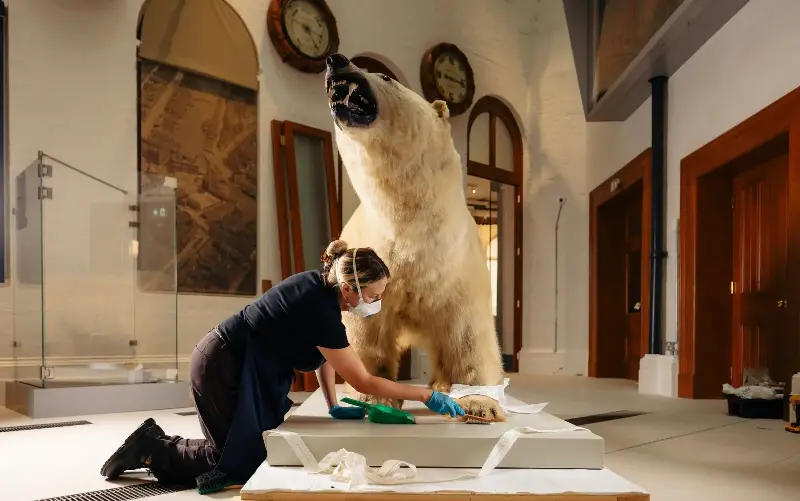
A stuffed polar bear called Erik was also a very popular exhibit when the museum closed for renovation in 2020. He was brought back from the Arctic in the 1860s by the crew of a Dundee whaling ship, the Erik (hence his name). Conservation work found Victorian newspapers bulking out his innards.
Six years and £20m later, the Maritime Museum is open again this week, with free entry as before, and 1,300 exhibits, half again as before. Projected film helps to tell the story of 800 years of Hull and the sea: dockers unloading bananas, tired-looking sailors’ orphans playing outdoor games. I tried out one of the hands-on activities by attempting to steer a ship in a simulator. We struck a steel buoy. I fear there were no survivors.
If scrimshaws on the Antiques Roadshow make your heart beat quicker, these folk art treasures scratched on whales’ teeth fill a wall of display cases. But my favourite exhibit in a bad-taste way was a coat-stand made from a narwhal tusk.
For me, it was a great pleasure just to clamber inside the building constructed in 1871 as the offices of the Hull Dock Company. It was to Hull what the Arsenale had been to Venice. In fact Hull’s fascinating Old Town is practically an island, surrounded by the Humber, the river Hull and the docks. The museum’s cheering restoration has the opposite effect to the horrible development since 1991 of the nearby Princes Quay shopping centre, in stained cladding on stilts in the dock.
For the first time, visitors to the Maritime Museum can climb a spiral staircase to look out of one of the three high cupolas that top the three-sided building. The Dock Company’s own workers built the proud structure in Ancaster limestone, lead and wood. On the first floor the windows of the magnificent court room are flanked by red Corinthian columns with gilt capitals, above which well-fed cherubs hold painted shields.
The Maritime Museum owes its existence to the scarcely believable figure of Thomas Sheppard, the first curator of Hull’s Municipal Museum in 1901, aged 24. He immediately made admission free. He had left school at 13 and become a railway clerk, taking advantage of free fares to visit the South Kensington museums and develop his geological expertise.
Sheppard, a great showman, oversaw the expansion of the popular Museum of Fisheries and Shipping in Pickering Park west of the city. The main Municipal Museum was destroyed by German bombing in 1943. In 1975, 30 years after his death, the Museum of Fisheries moved to the Dock Company building. And it has never looked more attractive than now.
Hull Maritime Museum at Queen Victoria Square, Kingston upon Hull, HU1 3DX, reopens on August 8; Mon-Sat 10-4.30; Sun 11-4.