



The world’s motoring press descended on Rome in May to pay homage to the Italian car industry’s latest showstopper. But while most were present for the unveiling of Ferrari’s first fully electric car, the Luce, I was perhaps fortunate to travel on to Bologna.
The launch of the Luce didn’t quite go as Ferrari had planned; the streamlined design was relentlessly battered by public and media alike. But the car I’ve travelled to Bologna to drive hadn’t been well-received by Enzo Ferrari 60 years ago either. Il Commendatore was famously critical of rivals, one reputed to have said: “It’s lucky the Miura is built by Lamborghini; otherwise it would be trouble for us.”
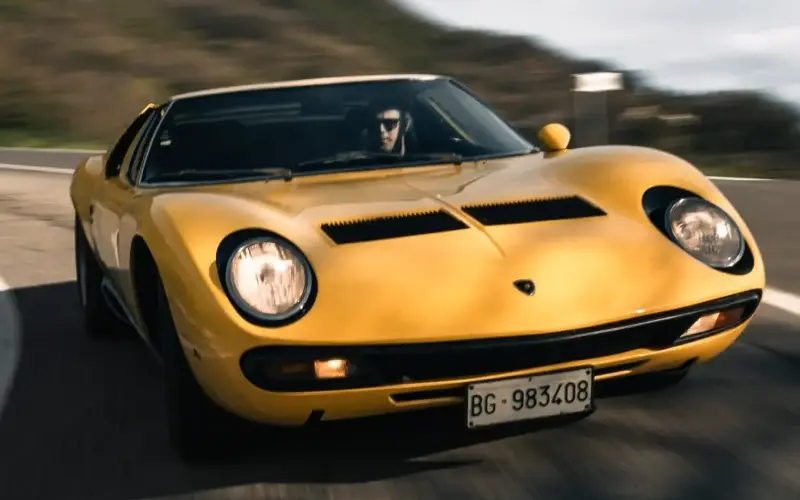
At least there are no awkward sideways glances when the bright yellow Miura is rolled out of a garage in front of me. Often described as the most beautiful car in the world, this Lamborghini is rightly spoken about in the same breath as the Jaguar E-Type and the Aston Martin DB5.
While Ferrari shares slumped after the Luce’s reveal in Rome, the Miura’s stock has never been higher. In March this year, an auction record was set – £4.9m for a 1972 P400 SV that spent half a century in the possession of a single American collector. The same car had sold in 2025 for considerably less.
Overnight sensation
At its Geneva motor show launch in 1966, the Lamborghini proved an overnight sensation, public and press amazed at Bertone studio’s futuristic design, penned by Marcello Gandini. It was another year before the first Miura came to the UK – the example on display at that year’s London motor show was bought by Thomas Cook of travel company fame.
The Miura is widely regarded as the first true supercar. The two-seat coupé pioneered a classic mid-engined, rear-wheel-drive setup for performance cars that is still employed by most manufacturers to this day.
Before the Miura, sports cars had been based on (mainly front-engined) designs that were conceived for motor racing. This low-slung two-seater, however, was specifically designed for the road and, capable of 170mph, became the fastest production car in the world.
Not bad for a company that started in 1948 making tractors. So successful was his agricultural machinery company that Ferruccio Lamborghini branched out into sports cars in 1963, starting with the V12-engined 350 GT (reputedly because of his dissatisfaction with Ferrari’s similarly powered grand tourers) before bringing out the game-changing Miura.
Celebrity status
The new Lamborghini quickly gained celebrity status – Frank Sinatra, Rod Stewart and Elton John just some of the stars unable to resist. And then there was that film. A Miura famously featured in the three-minute opening sequence of the original Italian Job, surging through the Alps to a Matt Monro soundtrack.
The reigning Formula 1 world champion, Lando Norris, is a more recent convert. The British ace can choose from a multimillion-pound collection of exotica to navigate the streets of his adopted home of Monaco; his eclectic garage ranges from a classic Fiat 500 to a Ferrari F40.
The McLaren driver, however, reportedly says his most prized possession is a deep blue Miura P400. Said to be worth at least £2m, the classic Lamborghini was a first proper gift to himself, as well as being his father’s dream car.
What’s it like to drive?
Despite measuring only 109cm high, with little in the way of rearward views because of a distinctive black louvred engine cover over a V12 unit with a reputation for overheating, the Miura is clearly a car that is much bigger than the sum of its hand-built parts.
Today, the 1972 P400 SV I’m driving has more than a whiff of petrol about the cockpit, in which the seats barely adjust and headroom was clearly an afterthought. The cramped interior is a greenhouse without air conditioning, while the overheating issues of the V12 just behind your head never really went away. Indeed, Lamborghini has fitted this example with two engine cooling fans, one operated via a switch on the roof.
As I quickly discover, the brakes and the steering are woefully inadequate too, while the clutch action is heavy, forcing my thighs to bang against the underside of the steering wheel. Forget a radio: The transversely mounted engine’s proximity drowns out any whinges of discomfort.
Driving the Miura is an assault on the senses and, lacking the power assistance that we now take for granted, a wrestling match. Even on the wide-open spaces of the Autodromo Riccardo Paletti, named after the Italian F1 driver, a copious amount of understeer is unavoidable.
An open-gated, five-speed gearbox requires deliberate, sharp shifts, but fortunately the pedals aren’t offset, as they are in many Italian sports cars. Push past 3,500rpm and the engine roar sends a wave of vibration pulsating through the monocoque chassis “tub”.
Modern counterpart
Lamborghini’s flagship model today is the £550,000 Revuelto – still with the company’s traditional V12 engine, but supplemented by a thoroughly modern battery pack. Outrageously overstated, the two-seat coupé will dash to 60mph in only 2.5sec and top 217mph.
As bookend models in the story of Lamborghini supercars, the Miura and the Revuelto are chalk and Gorgonzola, especially from behind the wheel. But despite the foibles of the Miura – launched the same year England last won the World Cup, remember – the noise, smells and sheer muscular workout, who would choose the Revuelto instead?
For the last word, I turn to the man who has looked after this bright yellow SV for almost 30 years. The cherished example belongs to Lamborghini’s historic collection at its Sant’Agata Bolognese HQ in the fertile plains north-west of Bologna, brought out only for special occasions before being cossetted away again for another decade.
Known only as Vincenzo, the car’s custodian admits he has put on a few pounds since he first drove it; it’s a squeeze when the Miura’s roofline is lower than your substantial waist. Folding up and then angling down into the driver’s seat requires athletic prowess.
“For me, there is only one supercar, the first and the original,” he said. “I know this car like my family – every part I would know blindfolded. It is theatre. You simply fall in love, and it lasts forever.”