



The hunter gatherers who first selectively bred wolves for specific tasks 11,000 years ago could never have seen this coming.
Last Thursday, a joint venture between Dallas’ Colossal Biosciences and defense technology company Anduril announced its emergence from stealth. The startup is called Warhound, and its pitch is that with Colossal’s genetic engineering capabilities and Anduril’s cybernetic augments, it can create a new generation of working military dogs better suited to, and better protected from, today’s advanced battlefields.
Warhound, which will based in Dallas, raised $200 million in its seed round led by Sequoia Capital. The release describes Warhound as a “vertically integrated platform, combining Colossal’s enhanced genetics platform and secure biobanking capabilities of America’s top-performing dog arsenal, controlled delivery through cloning with best-in-class training and animal care.” The dogs will then be outfitted with ear and eye protection from Anduril, as well as connected with Anduril’s AI and augmented reality Eagle Eye headgear technology, to enable dogs and their handlers better situational awareness in the field.
“Colossal has spent years pioneering breakthroughs in genetics, cloning, and animal biology, and now we’re applying that science to give these dogs the best possible chance at a long, healthy life and a successful mission,” said Texas billionaire entrepreneur Ben Lamm, the CEO and co-founder of Colossal. “If we’re going to ask man’s best friend to protect America, we owe it to them to use every tool at our disposal to protect them, too.”
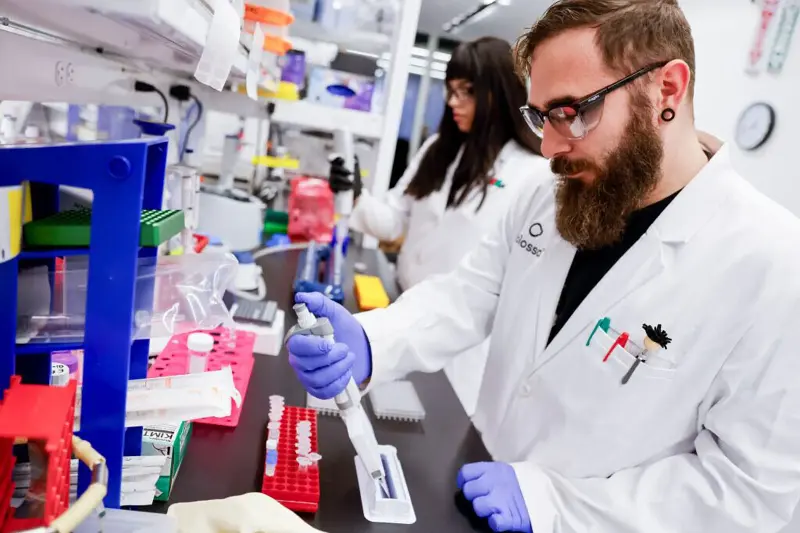
The Dallas headquarters of Colossal Biosciences, a startup that aims to bring various animals, including the woolly mammoth and dodo bird, back from extinction.
Courtesy of Colossal Biosciences Partnering with Anduril founder Palmer Luckey, Warhound is the latest startup Colossal has spun out. Astromech, which is applying AI to biological systems, reached a $3.8 billion valuation, while others have focused on biological solutions to plastic degradation and computational biology software.
The U.S. Army first established the K-9 Corps in 1942, and now the Military Working Dog Program has more than 2,200 working dog teams. Warhound says more than 80% of military dogs come from European breeders, but after a three-year training and procurement process, less than half are actually deemed fit to serve. By creating a domestic pipeline of working dogs, Warhound hopes to secure a crucial military asset while reducing the number of dogs that have to enter intense training and potentially wash out.
The startup is supported by the American Humane Society, which will certify Warhound’s training programs and support the reunification of retired dogs with their handlers.
“We owe these dogs a commitment to their well-being that matches their service to us. What excites me about Warhound is the opportunity to make health, welfare, and exceptional care fundamental to a working-dog program from the very beginning,” said Robin Ganzert, president and CEO of American Humane, in the release.
David Spirk, a Marine Corps veteran, has been named CEO of Warhound. He was formerly senior counselor at Palantir Technologies and has an extensive background in military intelligence.
“Our long-term goal is simple: healthier dogs, better-prepared teams, and more service members and first responders coming home safely,” Spirk said. “Leading Warhound, and strengthening America’s working-dog capabilities, is an opportunity to apply my experience to a mission I care deeply about: protecting people and helping the animals who support them.”